Still managing lease operations manually?
LeaseArc centralizes your lease data, automates repetitive tasks with AI, and gives better control over your portfolio.
- AI Lease abstraction
- Amendment tracking
- CAM reconciliation
- AI lease assistant

Use LeaseArc to handle large lease portfolios with less manual effort.
View pricing
The operational work involved in commercial lease management is a lot more complex than it appears on the surface. Every lease comes with its own clauses, amendments, renewal schedules, tenant obligations, supporting documents, and a lot more. And again, that information ends up scattered across various systems.
This may sound simple until your portfolio starts growing. At some point, managing commercial leases with spreadsheets and shared drives simply stops working. Trying to answer even simple questions, such as 'Which leases are renewing this quarter?' is going to take far more effort than it should when there are hundreds of different documents and multiple stakeholders involved.
That’s when commercial lease management software becomes a serious need. The goal isn’t just to store lease agreements in one place, but to support lease tracking, manage documents, and bring structure to leasing workflows across the commercial real estate portfolio.
In this guide, we’ll take you through what commercial lease management software is, key features, and the best solutions available today. We’ll also explain how to evaluate and choose one that fits the way your commercial leasing operations actually run.
Table of Contents
LeaseArc centralizes your lease data, automates repetitive tasks with AI, and gives better control over your portfolio.
Commercial lease management software is a tool designed to manage and administer lease agreements across the commercial real estate property portfolio. Commercial leases contain large volumes of information such as lease terms, amendments, renewal conditions, payment schedules, CAM reconciliation, and a lot of documents, adding to that. The software provides a structured way to keep this information organized and accessible throughout the leasing lifecycle.
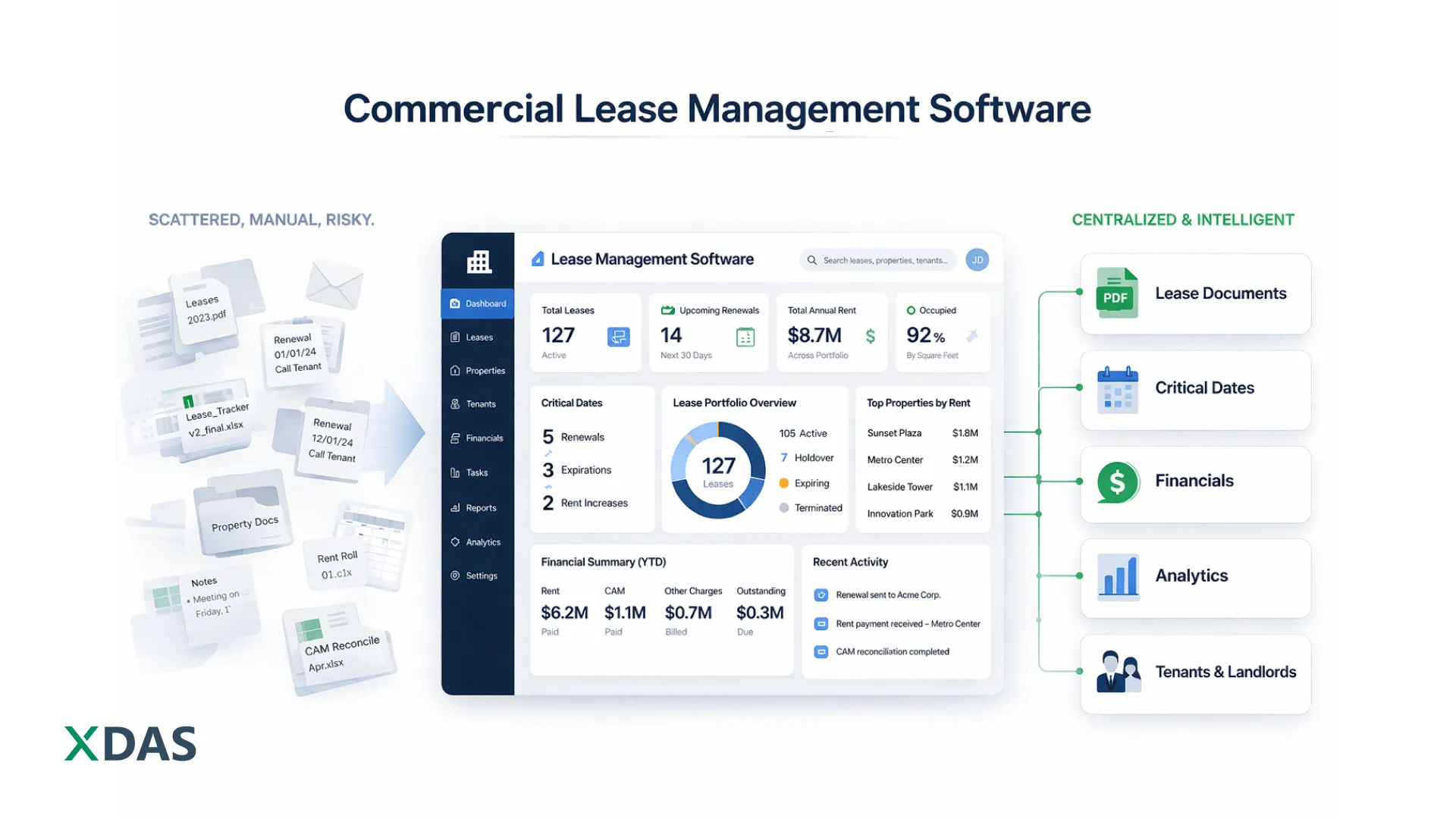
It is used by both tenants and landlords to maintain lease records, coordinate lease administration activities, and gain operational visibility across their portfolio.
Of course, there are many options available in the market to handle lease management, but not all of them are built the same. So, the question shifts from “which is the best?” to “which one actually fits my operations?”. Here are some of the most commonly used solutions, along with where each one fits best.

LeaseArc is an agentic AI solution for commercial lease management that works across your existing tech stack. It automates the entire leasing lifecycle end to end, with flexible, no-code workflows.
Real estate portfolios of all sizes, looking to automate their lease operations.
Custom pricing based on your usage.
Pros
Cons

Yardi is one of the most widely used commercial property management software. It offers a comprehensive suite of solutions for property management, accounting, leasing, and tenant engagement, which is why it’s a common choice for those handling larger portfolios.
Mid to large commercial real estate portfolios.
Pricing isn’t publicly disclosed and available upon request.
Pros
Cons

MRI Software is a well-established platform in the real estate space, used by both landlords and tenants. It covers property management, marketing, accounting, leasing and is often chosen by those who handle different types of portfolios.
Large commercial real estate portfolios and enterprise property managers.
Pricing is not publicly available and is typically usage based.
Pros
Cons

VTS Lease is primarily focused on leasing and asset management for commercial real estate. It’s commonly used by landlords and brokers to track deals, manage leasing activity, and get better visibility into portfolio performance.
Mid to large commercial real estate portfolios.
Starts around $20K/year, with subscription-based pricing.
Pros
Cons

Visual Lease is a leading lease management and lease accounting platform. It’s commonly used by finance and accounting teams to manage lease data, track obligations, and meet compliance standards.
Mid to large organizations with a strong focus on lease accounting and compliance.
Pricing isn’t publicly disclosed and available upon request.
Pros
Cons

Re-Leased is a cloud-based commercial property management software with AI-powered automation capabilities. It is commonly used by property managers and landlords to manage lease data, financials, and daily operations across their real estate portfolios.
Small to mid-sized commercial real estate portfolios.
Not publicly disclosed, typically subscription-based pricing with tiered plans.
Pros
Cons

Appfolio is an AI-powered property management platform with a strong focus on performance management. It includes tools for marketing, leasing, maintenance, communication, accounting and workflow automation.
Mid-to-large property management teams handling mixed portfolios.
Not publicly disclosed, typically subscription-based pricing with tiered plans.
Pros
Cons

CoStar Real Estate Manager is a commercial lease management platform that provides end to end lease lifecycle management. It’s commonly used to manage complex lease portfolios while staying compliant with accounting standards.
Large enterprises handling complex lease accounting and portfolio planning.
Pricing isn’t publicly disclosed and available upon request.
Pros
Cons

RealPage is a property management platform that supports commercial leasing, accounting, and operations in one system. It’s commonly used by enterprises that need a complete solution to manage the entire asset lifecycle.
Mid to large real estate portfolios and property managers
Pricing isn’t publicly disclosed and available upon request.
Pros
Cons

Buildium is a property management platform designed for smaller teams managing residential or mixed portfolios. It brings leasing, accounting, and basic operations into one system making it easier for day-to-day operations.
Small to mid-sized property managers and mixed portfolios
Starts at $62/month, with subscription based tiered pricing plans.
Pros
Cons
| Software | Commercial Focus | Rating | Best For | AI Capabilities | Pricing Model | Free Trial |
|---|---|---|---|---|---|---|
| LeaseArc | High | 4.7 | Portfolios of all sizes | Custom Quote | ||
| Yardi Voyager | High | 4 | Mid to large portfolios | Custom Quote | ||
| MRI Software | High | 4.2 | Large enterprise portfolios | Custom Quote | ||
| VTS Lease | High | 4.6 | Mid to large portfolios | Tiered plans | ||
| Visual Lease | High | 4.4 | Mid to large portfolios | Custom Quote | ||
| Re-Leased | High | 4.6 | Small to mid-sized portfolios | Tiered plans | ||
| Appfolio | Medium | 4.6 | Mid-to-large portfolios | Tiered plans | ||
| CoStar | High | 4.5 | Large enterprise-level portfolios | Custom Quote | ||
| RealPage | Medium | 3.8 | Mid to large portfolios | Custom Quote | ||
| Buildium | Low | 4.4 | Small to mid-sized portfolios | Tiered plans |
LeaseArc centralizes your lease data, automates repetitive tasks with AI, and gives better control over your portfolio.
The right tool isn’t the one with the most features, but the one that actually fits your operations.
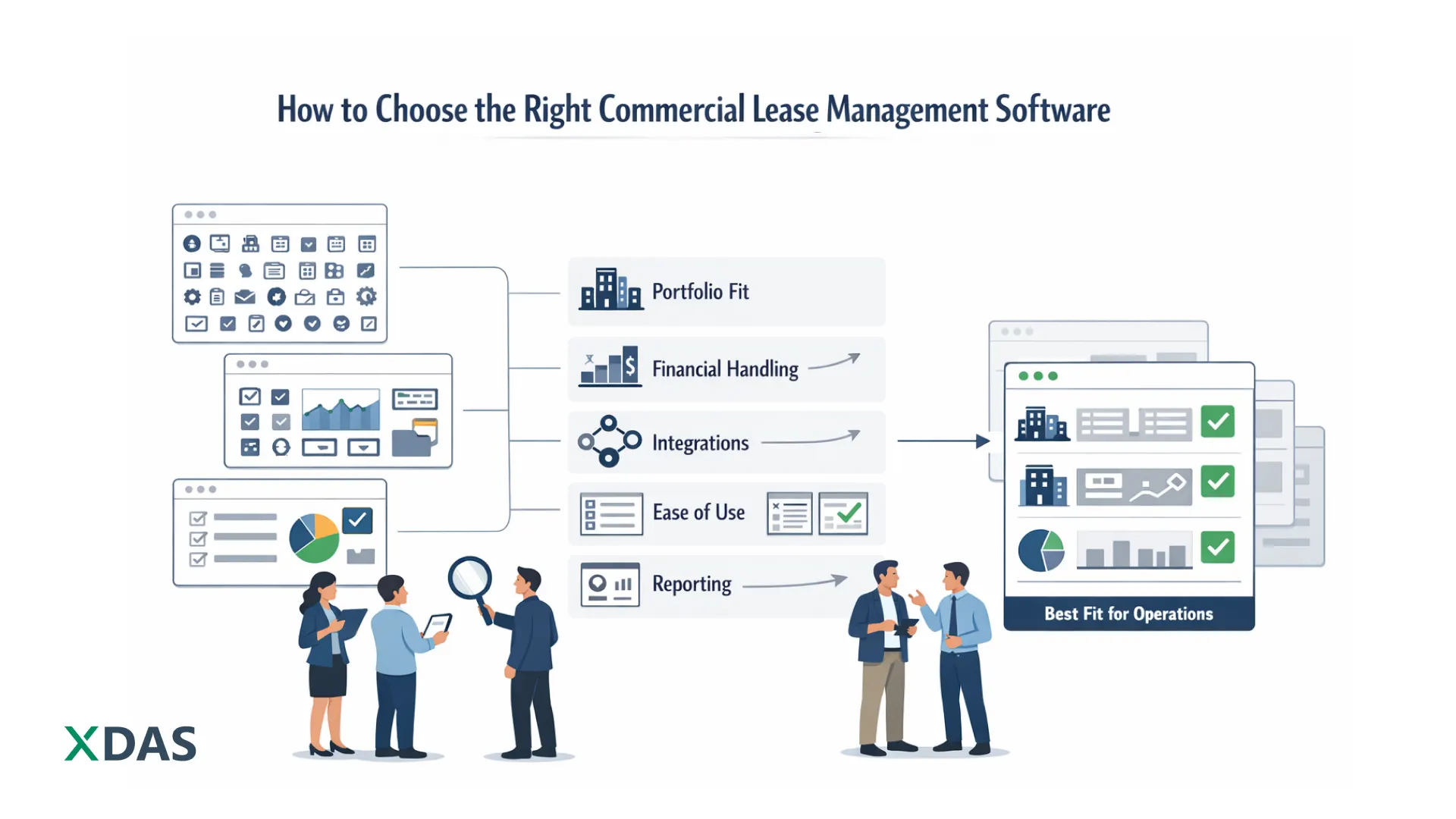
These are the core features that you should look for in a commercial leasing software, irrespective of whether you’re a tenant or landlord.
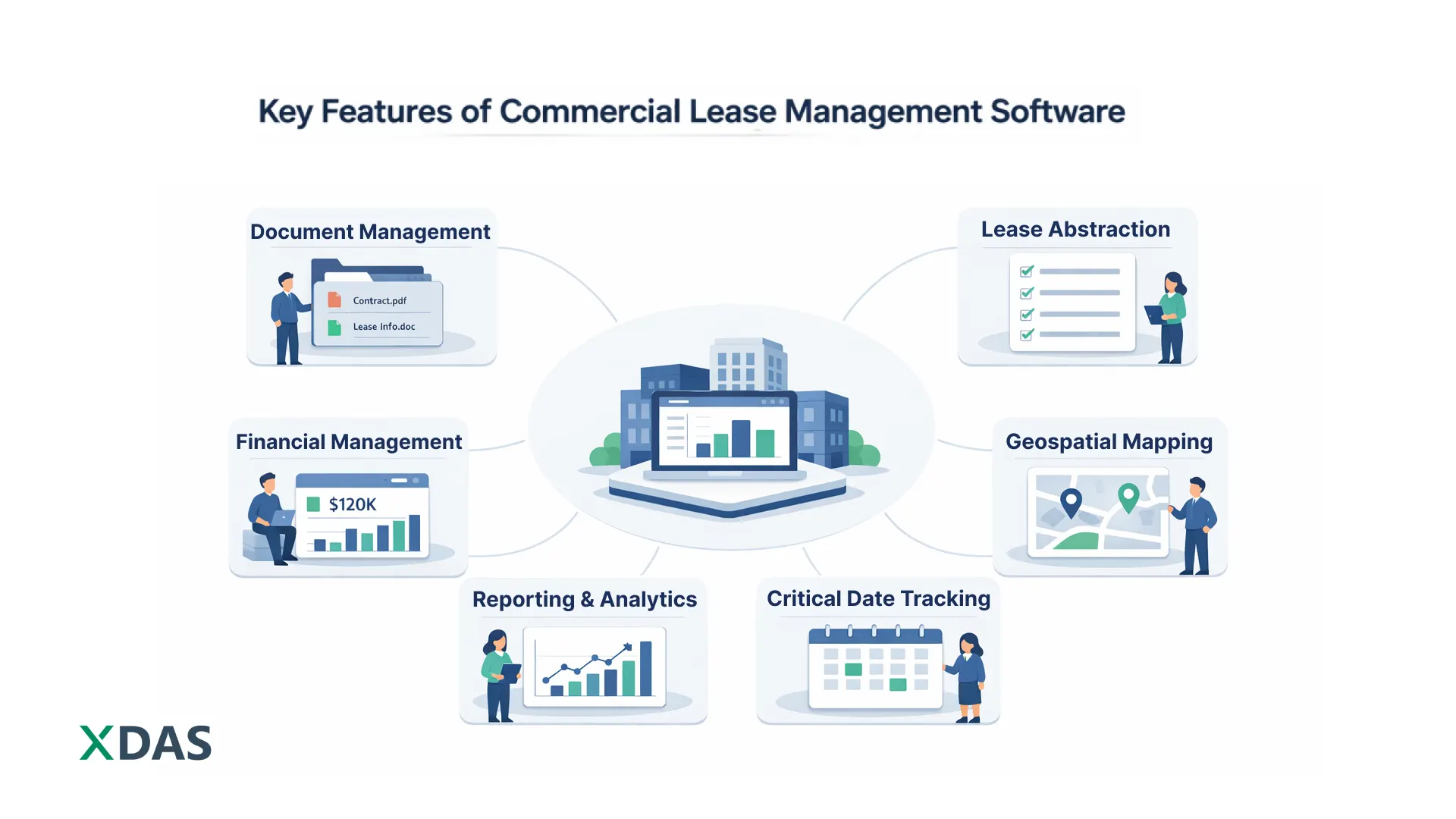
Commercial leasing involves a lot of paperwork, which is something you must be familiar with. And hence, document management is a feature that can’t really be compromised. Almost every lease management software provides a centralized repository where all lease-related documents are digitally stored and linked to the relevant lease. Ensure it also supports version tracking, audit trails, and e-signatures, making lease administration easier.
Lease agreements are usually very long and clause-heavy, and in most cases, key details like rent escalations, CAM charges, and renewal options are buried deep inside. Lease abstraction helps pull out these key data points and structure them properly using Optical Character Recognition (OCR) and AI. A 100 page lease document can be turned into a clean 2 page summary of material terms that is much more easier to work with.
Every lease has a set of important dates tied to it, such as start and end dates, renewals, expirations, notice windows (option to extend or option to terminate), COI expirations, and a lot more. The software should be able to track these critical dates and send timely reminders to avoid last-minute follow-ups or missed deadlines.
The financial structure of commercial leasing is pretty complex, as it involves multiple things, like base rent, NNN (triple net), percentage rent, CAM, taxes, CPI or indexed increases, and caps. On top of that, there are also scenarios like holdover rent penalties and periodic CAM reconciliations that need to be handled. Calculating all of this manually is highly prone to errors.
Your lease management software should be able to manage all these financial components in alignment with lease terms, so there’s clarity on what needs to be billed or paid without constant cross-checking of documents.
Once the lease data is structured, you should be able to actually use it and not just store it. Reporting and analytics let you see what’s happening across your portfolio, including upcoming events, income, and expenses. You should be able to build custom dashboards and filter data by property or lease to easily extract the insights.
For landlords, it involves tracking KPIs like rental income, Net Effective Rent (NER), lease expirations, and occupancy rate. And for tenants, it’ll be occupancy cost, upcoming obligations (renewals, escalations), and cost per location.
For larger portfolios, location context matters. With GIS integration, some platforms let you view property locations visually on a map to analyze proximity and market trends. Geospatial mapping is especially useful for tenants managing multiple locations (for example, retail chains looking at store coverage or overlap).
LeaseArc centralizes your lease data, automates repetitive tasks with AI, and gives better control over your portfolio.
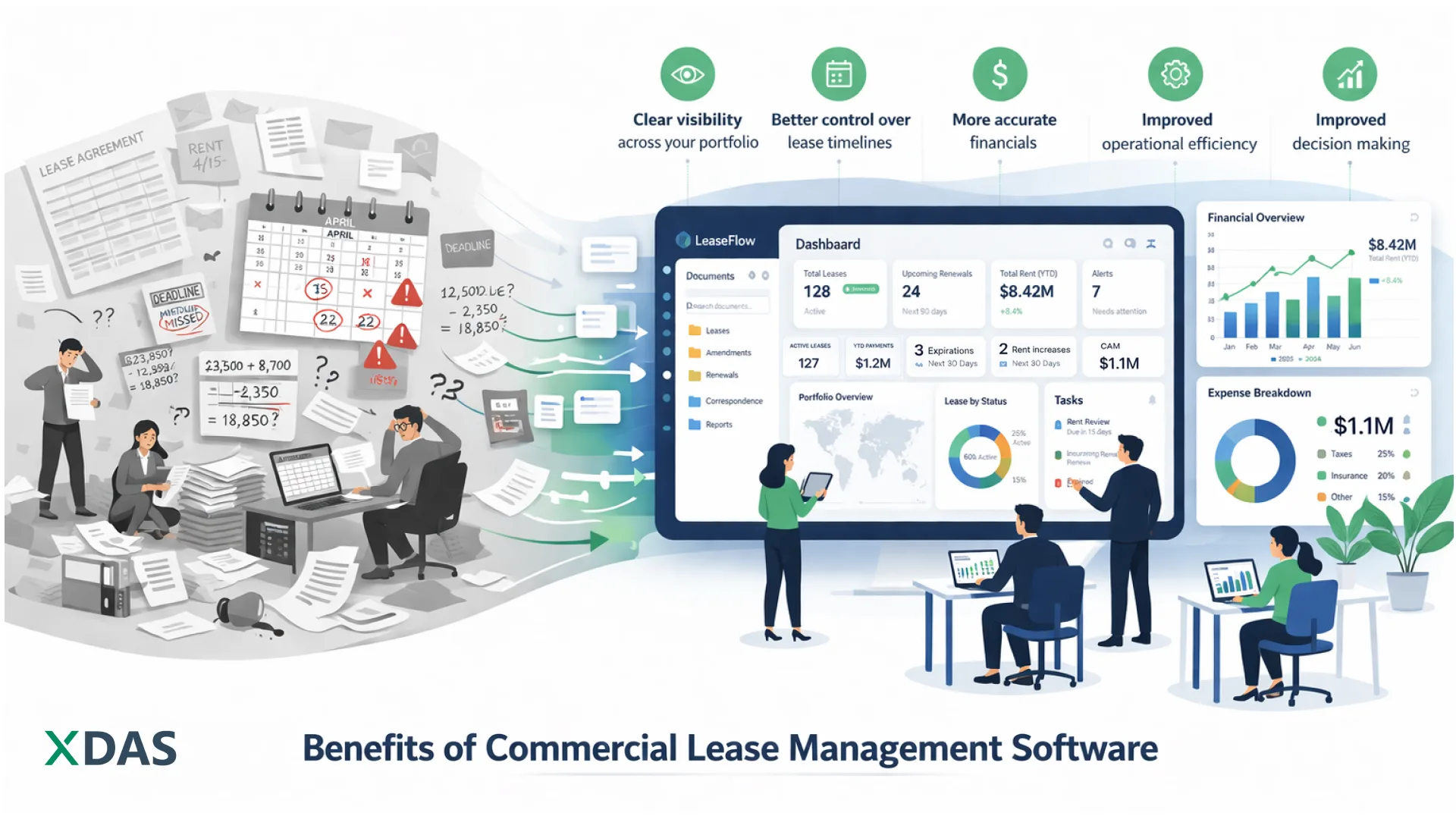
As the portfolio expands, it naturally becomes harder to get a reliable view of what’s happening across properties, especially when the lease data is scattered. With all your lease-related information in one place, you can effortlessly manage and track the status of your entire commercial real estate portfolio. No more juggling between PDFs, spreadsheets, or shared drives every time to find something.
Managing lease renewals, expirations, rent increases, and other key dates manually is a lot harder than it looks. Commercial lease management software simplifies this. It keeps you updated on upcoming events by sending automatic reminders to avoid last-minute rush or missed deadlines.
Commercial leases have ‘n’ number of financial components, and over time, even a minor error that goes unnoticed could add up. With a system in place to manage all of the billing, payments, and reconciliations, you get more control over your lease-related financials, reducing discrepancies and making it more reliable. Therefore, you don’t have to second-guess the numbers.
A lot of lease management work is often repetitive, like updating records, tracking key details, and cross-checking documents. It might seem small, but over time, this adds up. Lease management software reduces the time spent on such tasks, making management of large portfolios more efficient without increasing the manual effort, while also reducing the risk of errors.
Landlords can gain a clearer understanding of how their portfolio is performing, which makes it easier to optimize profits and cut down vacancies. Tenants, on the other hand, can better grasp their occupancy costs and plan lease-related expenses across locations. With reliable insights, both parties can make more informed, data-driven decisions.
Commercial lease management software is usually priced based on the size of your lease portfolio and the features you need. Most providers charge an initial setup fee, followed by a monthly or annual subscription based on the number of leases managed.
The initial setup fee typically covers activities such as data migration, system configuration, and onboarding. The ongoing subscription can vary depending on the number of leases, users, and the modules you opted for, such as lease accounting, reporting, document management, and integrations.
See what lease management software like LeaseArc could cost for your portfolio.
Our team will review your portfolio details and get in touch with you shortly.
To estimate the ROI of the commercial lease management software, compare the value you gain from the software versus what you spend on it.
ROI = (Total savings – Total costs) / Total costs * 100
Where,
Total savings = Time savings + Revenue recovered + Headcount cost avoided
Total costs = Software Licensing + Implementation + Training + Data migration costs
Let’s break this down with a simple use case. Consider you have a portfolio of 200 leases.
Annual savings = Time spent per week on manual work * hourly cost * 52
10 * 15 * 52 = $7800/year saved
2M *0.5% = $10000/year revenue recovered
$30000/year headcount cost avoided
Total savings = $7800 + $10000 + 30000 = $47800/year
Total cost = $18000 + $6000 + $3000 + $3000 = $30000/year
ROI = ($47800 - $30000) / $30000 * 100 = ~60%
The ROI might be slightly lower than anticipated for the first year, because of the implementation and setup costs; however, over time, you will see the true returns.
Commercial lease management software handles core functions of leasing, which include tracking leases, storing documents and managing financials. But the real challenge is not just managing data; it’s coordinating multiple teams and systems to get the work done.
LeaseArc is built to solve that.
It works as an AI lease operations agent that integrates across your existing tech stack and automates your leasing operations end to end. Instead of you jumping between listing sites, ERP, CRM, drives, and email threads to trigger the next step in the leasing process, LeaseArc handles these in a structured way.
From publishing listings and capturing leads, to tenant screening, lease abstraction, handling negotiations, and managing lease administration, LeaseArc keeps everything moving without requiring manual intervention. At the same time, human-in-the-loop (HITL) integration ensures critical decisions are still reviewed wherever needed. With no-code configuration, you can easily create workflows without needing any technical expertise. The result is less manual effort, faster execution, and more consistent leasing operations as your portfolio scales.
If this sounds like something you need, book a personalized demo to see how LeaseArc could automate your leasing workflows.
What is the difference between lease management software and property management software?
Lease management software focuses specifically on managing lease agreements, which include tracking clauses, financials, and critical dates. Property management software covers broader operations, which include tenant management, communication, and maintenance.
Which is the best commercial lease management software?
There’s no single “best” commercial lease management software. The right choice depends on your portfolio size and use case.
How much does commercial lease management software cost?
Cost of commercial lease management software typically ranges from $50 to more than $2000 per month. Most software vendors will provide a quote based on the modules you require, the size of your portfolio, and the level of customization you need.
How long does it take to implement lease management software?
The time to implement depends on the complexity of your portfolio. Smaller setups can take a few weeks, while enterprise implementations may take a few months.
LeaseArc centralizes your lease data, automates repetitive tasks with AI, and gives better control over your portfolio.
Written by: Suvetha Sukumar


