
You’ve checked your Spotify Wrapped. You’ve seen your top songs, your “listening personality,” However, it’s time for a different kind of year-end review. Welcome to AI Wrapped 2025 by Xtract.io. We’re reviewing the 2025 reality check to help you architect a 2026 strategy that paves the way for a production-ready, agent-native workforce.
What Bill Gates said about automation in the past, feels like it was whispered directly to the year 2025: “The efficiency of a technology will be optimized or diminished solely based on the operations”.
As we wrap up 2025, these words carry a lot of weight, we can attribute these words to the AI landscape as well. Indeed, if 2023 was the year of “AI awe” and 2024 was the year of “AI panic,” then 2025 has officially been the year of the AI reality check. We’ve spent the last twelve months realizing that while AI is magical, our legacy business processes are… Well, not.
At Xtract.io, we’ve watched this journey closely. For instance, we saw boards of directors demand “Agentic AI” by Q3, only to find that their digital agents were getting stuck on the same messy data and clunky mainframe screens that have frustrated their human employees for decades.
Consequently, as we look toward 2026, let’s talk about what actually happened this year, what stayed behind, and how we are moving toward a future defined by a agent native workforce.
Your top “genre”: The cultural vibe
Before we dive into the spreadsheets and ROI, we have to acknowledge that 2025 was the year AI became human. It moved out of the data center and into our group chats.

Remember the Nano Banana craze? It seemed like a fun toy, everyone turning their digital identity into a hyper-realistic, 3D-collectible figurine. But for businesses, it was a massive signal: Multimodality has arrived. We realized that if an AI can understand the physics, texture, and lighting of a plastic toy box, it can understand a complex warehouse floor or a handwritten invoice just as easily.
We saw the “Ghiblification” of our social feeds and the viral, surreal humor of AI-generated content. These weren’t just memes; they were training wheels. It showed us that the interface of the future isn’t a search bar that answers; it’s a medium to build conversations that can create breakthroughs in the future.
Your business stats: The “reality gap”
While the internet was busy with Nano Bananas, enterprise leaders were hitting a wall. The promise of “Agentic AI”, AI that doesn’t just talk, but actually does work, faced a sobering reality check.
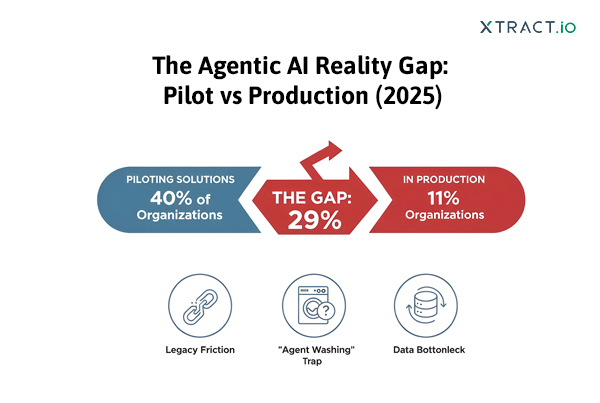
According to Deloitte’s 2026 trends, while nearly 40% of organizations were piloting agentic solutions this year, only a tiny 11% actually made it into production. Why the gap?
1. The Legacy friction
We built most of our businesses for ‘carbon-based workers (humans). As a result, we have processes that require clicking through 50 different mainframe screens to check a shipping status. When we tried to “layer” an AI agent on top of that, it failed. Why? Because the system wasn’t designed for a digital worker that thinks in microseconds. Like Toyota discovered, the win isn’t in making the AI click the screens faster; it’s in giving the AI direct access to the data so the screens aren’t even necessary.
2. The “Agent washing” trap
2025 was the year of “Agent washing.” Every vendor rebranded their 2010-era chatbot as an “Autonomous Agent.” This led to what many are calling “Workslop”, AI-generated noise that actually made processes less efficient. True agents require reasoning, not just prediction.
3. The Data bottleneck
This is the one we feel most at Xtract.io. Nearly half of all organizations cited “searchability” and “reusability” of data as their #1 barrier. If your data is trapped in a messy basement of silos, your AI agent is essentially a genius worker with a blindfold on.
The 2026 playlist: Architecting the silicon workforce
As we look forward to 2026, the strategy is shifting. We are no longer just “using AI tools.” We are managing a silicon workforce. This requires a fundamental reimagining of what “work” actually is.
From “pipes” to “indexes”
For years, we’ve relied on ETL (Extract, Transform, Load) to move data around. In 2026, that’s too slow. The “Agent-Native” enterprise will look more like Google. Instead of moving data, we will index it using knowledge graphs. This allows agents to understand the context of your business, the relationships between customers, products, and supply chains, without needing a new data pipeline for every task.
The autonomy spectrum
In 2026, you’ll need to decide where your processes sit on the spectrum:
- Augmentation: AI acting as add-ons to your team to enhance their quality of work.
- Automation: AI taking over repetitive tasks within a human-designed process.
- True autonomy: AI-designed processes where humans act as “Agent supervisors,” only stepping in for high-level judgment and empathy.
Data as “digital exhaust”
Here is the most exciting shift for 2026: Every action your silicon workforce takes,a new kind of data is created, digital exhaust. Every decision an agent makes, every token it generates, refines your operations in real-time. Leading companies won’t just use data to run AI; they will use the data created by AI to reinvent their competitive advantage.
What’s dropping in 2026: What stays and what changes?
What is here to stay
- The focus on ROI: AS 2026 approaches, the time and the luxury we had for AI experimentation is over. Hereafter we need to prove the AI impact using ROI, right on the bulls eye, without that we are not getting further investments.
- The human presence: Whatever new advancements come, AI will not replace core human characteristics like empathy, ethics and pivoting decisions based on the context. Because at the end of the day humans are the architects and AI will be the workforce.
What is bound to change
- Start small can be your mantra for AI models: 2025 taught us one thing for sure, we are not going to need mighty Large Language Models for every task. Sometimes all it needs is specialized lean models (Small Language Models) that are fast, domain specific and cost effective.
- The big shift from human native to agent native architectures: The current systems we are using are built by humans for humans. Meanwhile, in the coming year we will start building systems that are specifically created for our digital workers to consume.
The Xtract.io perspective on AI : Build your foundation
There will be thousands of inferences, expert advice and multiple takeaways from 2025, but if you have to choose one, it should be a single truth. Though the power of data is massive, it is not enough, your must have AI -ready data, that is the whole point.
If your 2026 business vision is to build an AI workforce, focus on your foundations. You need a rock solid one, not one of sand. To be precise , you should be confident enough that your data is clean, searchable and contextually indexed that your AI agents can consume without any roadblock. Your AI objectives might be different but for whatever circumstances, the thumb rule is one and the same: reimagine the work, not rework the existing.
The bottom line: Ready for the 2026 world tour?
The “Agentic reality check” of 2025 wasn’t a failure, it was a graduation. We’ve moved past the hype and into the hard, rewarding work of structural transformation.
In 2026, the question would not be “ Will AI work for my business” It’s “Is my business designed to let AI work?”
Success in the coming year won’t go to the company with the flashiest chatbot. It will go to the company that builds the best environment for their mixed workforce of humans and agents to collaborate.
Are you ready to architect your 2026 for AI?