Still tracking lease documents across shared drives?
Keep every lease document organized, connected, and easy to find with LeaseArc.
- Centralized repository
- AI lease abstraction
- Complete audit trail
- Amendment handling

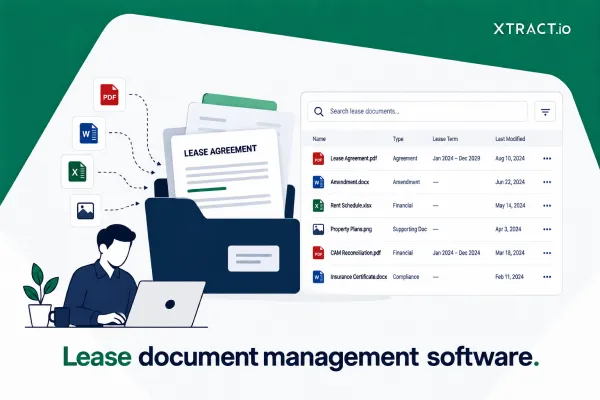
A single commercial lease rarely stays a single document for long. There's the original agreement, then the first amendment, a certificate of insurance, an estoppel letter, a renewal notice, maybe a side letter nobody remembers signing. Multiply that across a portfolio of even 50 properties, and "where's the latest version of this lease?" becomes one of the most time-consuming questions a leasing or accounting team asks every week.
Lease document management is built to answer that question in seconds instead of hours.
Unlike general-purpose file storage, lease document management software is built around the lease as the unit of organization. Every document, the base lease, every amendment, every notice, every certificate gets linked to the right property, the right tenant, and the right clause, so nothing has to be manually cross-referenced or re-found.
In this guide, we'll cover what lease document management software does, the features that separate a real system from a glorified file cabinet, and how the six leading platforms compare on ratings, pricing, and fit.
Table of Contents
Keep every lease document organized, connected, and easy to find with LeaseArc.
Lease document management software is a system for storing, organizing, and retrieving every document tied to a commercial lease: the original agreement, amendments, exhibits, certificates of insurance, notices, and correspondence in a structured, searchable, and access-controlled way.
Rather than treating documents as static files in a folder, the software links each one to the underlying lease record. A rent escalation clause, the amendment that changed it, and the correspondence that triggered the change all stay connected and retrievable from one place, instead of living in three different systems.
It's typically one module within a broader lease management or lease accounting platform, though some vendors lead with document handling as their core differentiator.
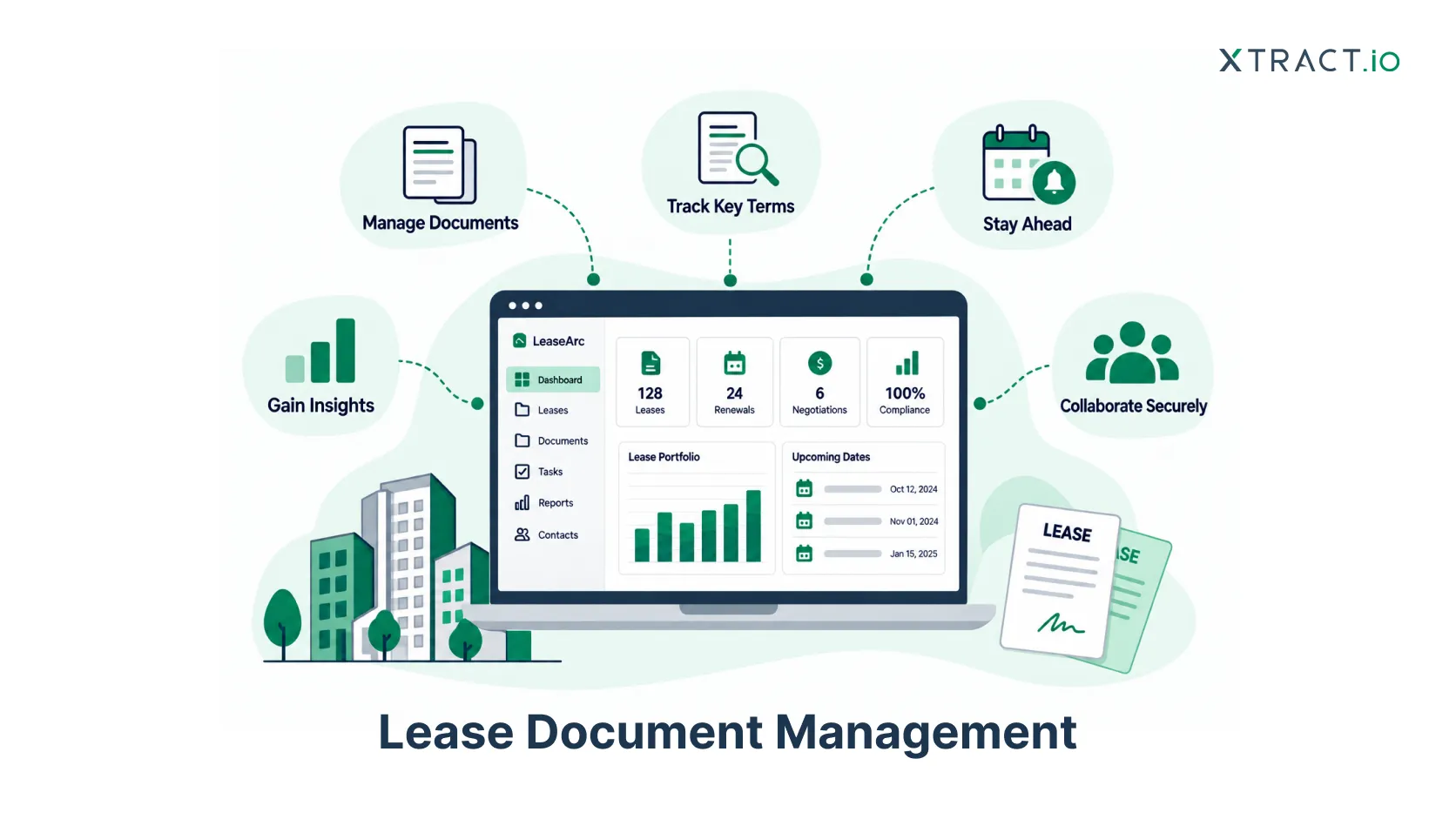
Lease document management software can handle the different documents that build up around a lease, keeping them organized and connected to the right lease record.
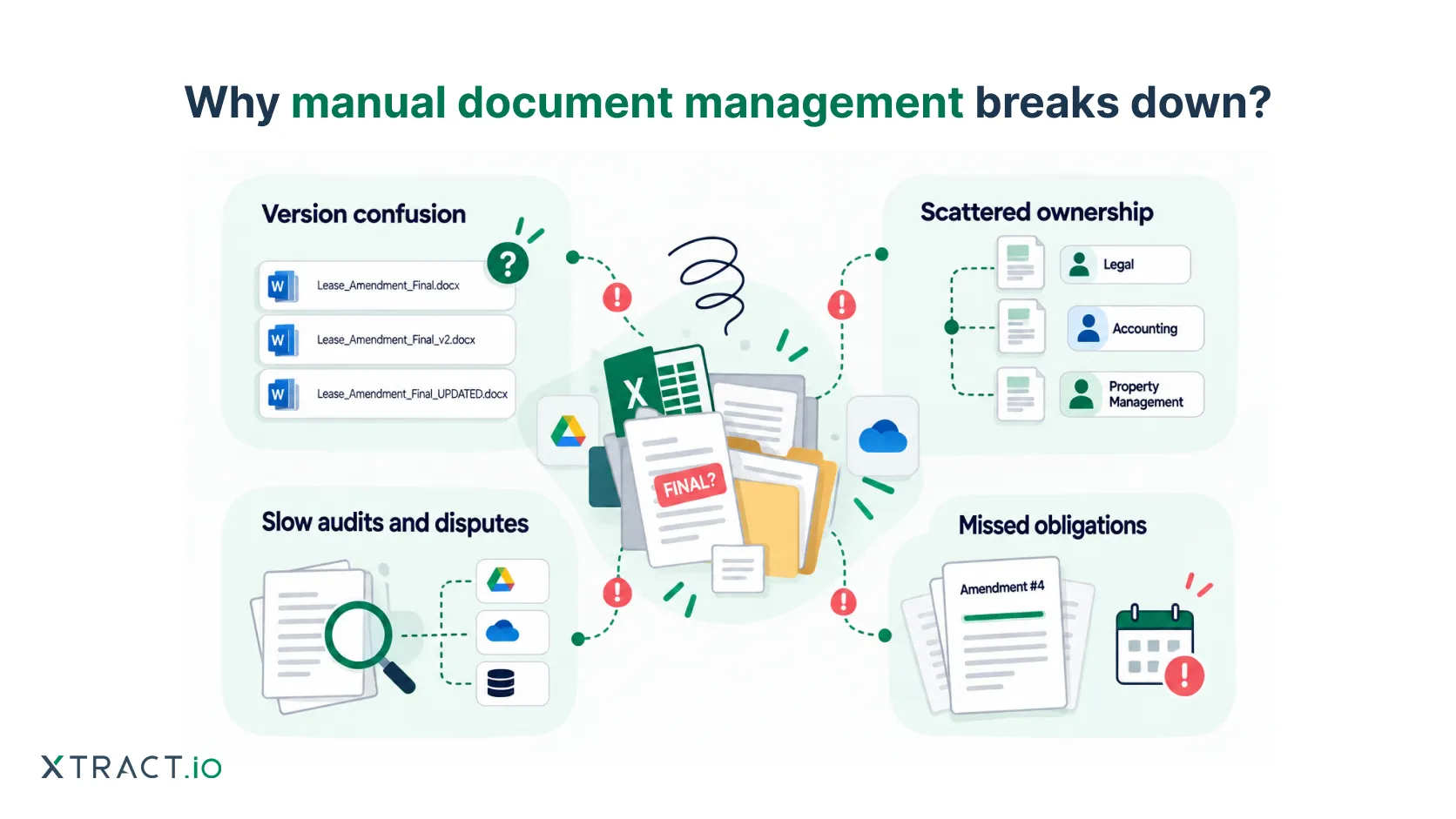
Spreadsheets and shared drives work fine for a handful of leases. The cracks start showing as a portfolio grows:
Every document tied to a lease, the base agreement, amendments, exhibits, insurance certificates, and notices should live in one system, linked to the correct property and tenant record, rather than split across drives, inboxes, and physical files.
The software should track every change to a document, who made it, and when, so there's always a clear record of which version is currently in effect and a defensible audit trail if that's ever challenged.
Documents, including scanned originals should be searchable by clause, term, or keyword, not just by file name. Being able to search "termination option" across an entire portfolio and get every relevant lease back saves hours compared to opening files one by one.
Built-in or integrated e-signature support lets amendments, renewals, and notices get executed and filed automatically, without a separate manual upload step.
Not every document should be visible to every user. Role-based permissions let you restrict sensitive terms like actual rent or exit clauses to the people who need them.
Amendments should be connected to the base lease they modify, with the software reflecting the current, effective terms rather than leaving users to manually reconcile the original document against every subsequent change.
Document data should flow into the systems that use it lease accounting, CAM reconciliation, critical date tracking, instead of requiring manual re-entry.

LeaseArc is an AI-powered lease intelligence platform designed for commercial lease management that centralizes lease documents alongside abstraction, administration, and workflow automation, rather than treating document storage as a standalone task.
Portfolios of any size looking to unify document storage with lease intelligence and automation, not just filing.
Custom pricing based on your usage.
Pros
Cons
Visual Lease is a lease management and accounting platform widely used by finance and accounting teams, built primarily as a financial subledger with document storage tied to lease accounting records.
Mid-to-large organizations prioritizing lease accounting compliance alongside document storage.
Pricing isn't publicly disclosed; based on number of leased assets managed.
Pros
Cons

Leasecake is a lease and location management platform aimed at smaller teams and multi-location operators who need an easier on-ramp than enterprise lease accounting suites.
Small to mid-sized multi-location businesses that need straightforward document and date tracking without a heavy implementation.
Pricing not publicly disclosed.
Pros
Cons

Prophia is a cloud-based lease abstraction and document intelligence platform that uses AI to extract data from lease documents and hyperlink it back to the original source.
Property owners, asset managers, and brokers who want document management paired with portfolio-level reporting.
Custom pricing, contact for quote.
Pros
Cons

Tango (formerly Tango Analytics) is an enterprise real estate and facilities platform that includes lease administration and document management alongside portfolio strategy and project management.
Enterprises that want lease documents managed alongside broader real estate, facilities, and capital projects operations.
Pricing not publicly disclosed.
Pros
Cons
| Software | Rating | Centralized repository | Version control | OCR / full-text search | Amendment linking | Best for |
|---|---|---|---|---|---|---|
| LeaseArc | 4.7 | Portfolios of any size wanting document + lease intelligence | ||||
| Visual Lease | 4.4 | Accounting & compliance teams | ||||
| Leasecake | 4.7 | Limited | Limited | Small to mid-sized multi-location teams | ||
| Prophia | 4.5 | Owners focused on portfolio reporting | ||||
| Tango | 4.3 | Enterprise real estate & facilities teams |
Keep every lease document organized, connected, and easy to find with LeaseArc.
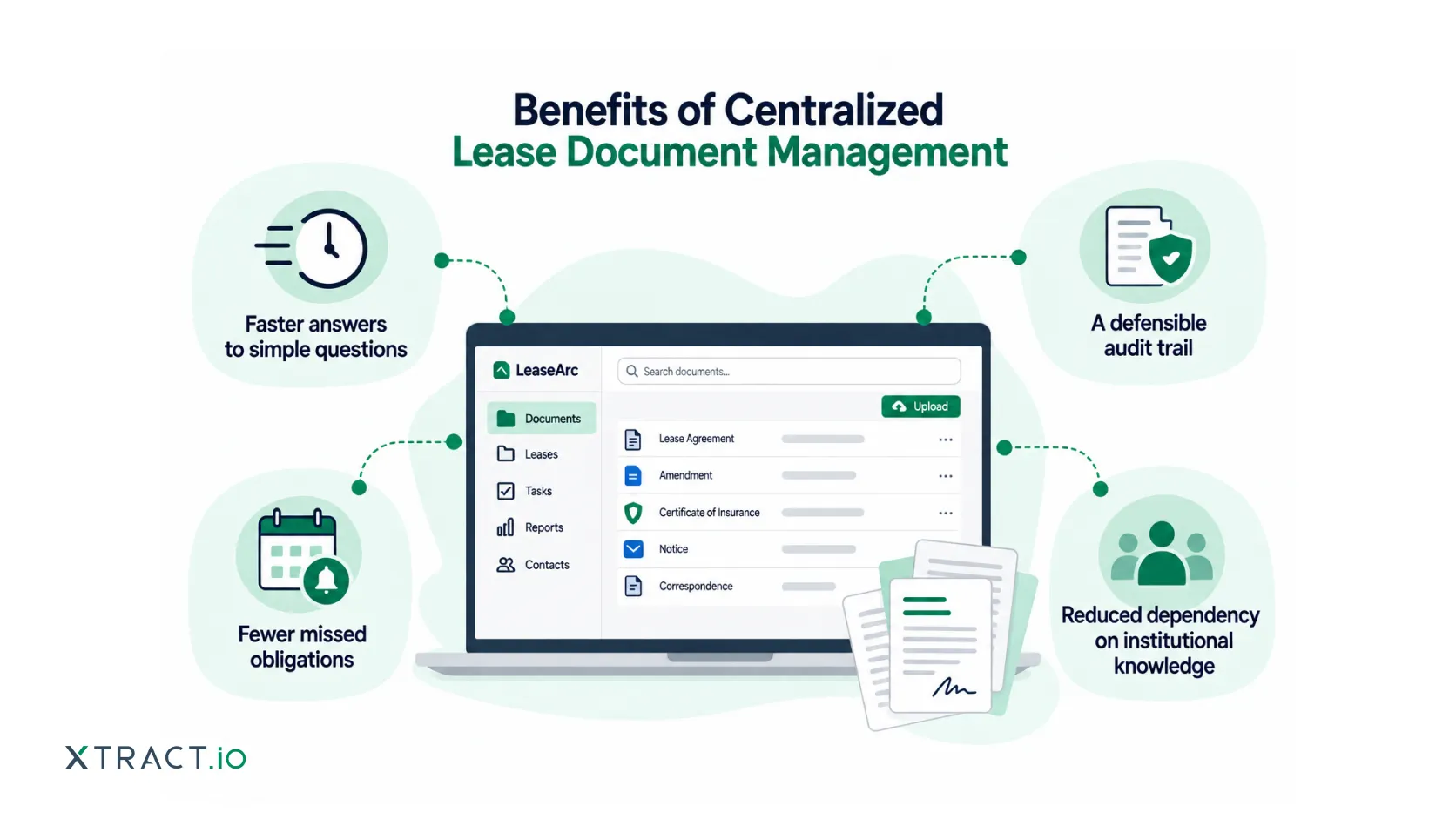
"Where's the current insurance certificate for this tenant?" should take seconds to answer, not require pinging three people across two departments.
When every version and every change is tracked, responding to an auditor, lender, or dispute becomes a matter of pulling a record, not reconstructing one from memory.
Amendments and notices linked directly to the base lease make it far less likely that a changed term gets missed simply because it lived in a separate file.
When document organization lives in a system instead of in one person's inbox or filing habits, the loss of that person doesn't mean the loss of the portfolio's institutional memory.
Consider a portfolio of 150 leases, where staff currently spend an average of 3 hours per week locating and reconciling lease documents across shared drives and email, at an average loaded hourly cost of $40.
Annual time cost = 3 hours × $40 × 52 weeks = $6,240/year
Add in the cost of slower dispute resolution and occasional missed obligations, conservatively estimated at $8,000/year in recoverable value once documents are centralized and searchable.
Total estimated annual value = $6,240 + $8,000 = $14,240/year
Against a typical software cost in the $6,000–$12,000/year range for a portfolio this size, centralizing document management can pay for itself within the first year, before accounting for the harder-to-quantify benefit of faster audits and fewer disputes.
Keep every lease document organized, connected, and easy to find with LeaseArc.
Most platforms on this list treat document management as a standalone task: store the file, tag it, done. That's useful, but it stops short of what documents are actually for supplying reliable data to every downstream decision, from renewals to CAM reconciliation to compliance reporting.
LeaseArc goes beyond storing and organizing lease documents. It connects the information within each document to the broader lease record, turning documents into a source of lease intelligence.
With AI-powered lease abstraction, LeaseArc extracts key terms and clauses and links them back to their original source, making lease information easier to search, verify, and use. Teams can quickly understand what a lease says, trace information back to the source document, and work with a more complete view of their lease portfolio.
This connected approach brings lease documents, structured data, and workflows together in one platform, helping teams move from simply managing documents to using lease intelligence to manage the lease lifecycle.
Book a personalized demo to see how LeaseArc could organize your lease documents.
What is lease document management software?
Lease document management software helps businesses store, organize, search, and manage lease-related documents in one place. It keeps leases, amendments, certificates, notices, and supporting documents connected to the right lease and property, making them easier to find and keep up to date.
Can I use general file storage like SharePoint or Google Drive for lease documents?
You can, but general-purpose storage doesn't understand leases; it can't link an amendment to the clause it changes, track critical dates automatically, or flag when a document is out of date. Purpose-built lease document management software is designed specifically to handle those relationships.
Is lease document management software only for landlords?
No. Tenants managing multiple leased locations benefit just as much, particularly for tracking obligations, renewal windows, and certificates across a portfolio of leased sites.
What is the best lease document management software?
There's no single "best"; the right choice depends on portfolio size, complexity, and whether document management needs to connect to broader lease intelligence or just serve as storage. LeaseArc, Visual Lease, Leasecake, Prophia, and Tango each serve different portfolio types and priorities.
Do I need separate software for lease accounting and lease document management?
Not necessarily. Lease accounting handles financial calculations and compliance, while lease document management focuses on storing, organizing, searching, and tracking lease documents. A platform that supports both can eliminate the need for separate software.
Keep every lease document organized, connected, and easy to find with LeaseArc.


Digital Marketing Lead
B2B Growth and Demand Generation professional specializing in digital marketing, paid media, SEO, automation, and AI-driven optimization.
Xtract.io provides cognitive data automation solutions, enabling businesses to transform their operations seamlessly. Our flagship platform, XDAS, is designed to streamline complex workflows and efficiently manage large volumes of data. With 200+ solutions and workflows, XDAS accelerates deployment and enhances operational performance, driving tangible results.
+19295566370
[email protected]Prince Kushal Towers, Ground Floor, A Wing, No. 138/805, Anna Salai, Chennai, Tamil Nadu 600002

