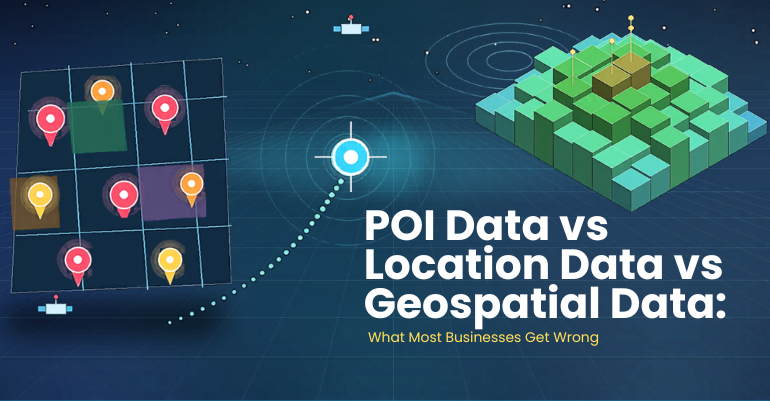
Geospatial data is any information with a geographic component, such as addresses, coordinates, or spatial connections, that can be mapped and analyzed. It is the fundamental component of smart cities, logistics, real estate, and any location-based services.
A particular subset of geospatial data that offers the required contextual information about a location is Points of Interest (POI) data. POI data delivers more details about a location beyond just defining a specific place. It converts raw points into rich, practical knowledge that lets businesses, governments, and entrepreneurs make decisions that advance their objectives and long-term growth.
Why is POI data an essential subset of geospatial data?
Besides providing a location’s address, Points of Interest (POI) data includes additional details, such as the area around a location, the amenities it offers, and the hours that a store is open and closed. These enriched POI data points provide valuable insights that support data-driven decision-making and strategic planning for businesses. Here are a few ways businesses use POI data in geospatial mapping.
- Logistics departments analyze optimal routes and plan deliveries by mapping accurate locations, thereby reducing delays and improving fleet efficiency.
- Retail businesses use POI data to analyze neighborhood and competitor locations and identify the best sites to expand their markets.
- City planners analyze existing amenities in a neighborhood to identify underserved areas and construct new infrastructure.
- Marketing industries refine their strategies using POI data as it reveals trends in consumer access and business distribution.
Although there are several POI data providers and open sources, the effectiveness of POI data depends on its accuracy and completeness, making reliable providers crucial for businesses.
Top 7 POI data providers you should know
This growing reliance on geospatial data has also increased the demand for reliable POI data providers. Each POI data provider curates unique datasets to serve different industry needs. Here are the top seven companies recognized for depth and accuracy in providing POI data across industries.
1. Xtract.io
Xtract.io offers a POI database with more than 6 million POIs and millions of polygon boundaries that are kept up to date. Every 30, 60, or 90 days, their database is updated to provide businesses with new, practical location intelligence.
Their POI data is ideal for businesses and organizations engaged in evaluating the best sites for entering new markets, targeting consumers according to their location and interests, analyzing competitor locations and market presence, assisting in infrastructure development and city planning, and enhancing logistics and distribution strategies.
Strengths
- They provide comprehensive coverage across 11 key industries and 118 sub-industries.
- Over 95% accuracy in the data, which is achieved through advanced automation and meticulous manual validation.
- Each POI includes more than 40 attributes, such as business name, address, and phone number, organized within a global schema.
- The data is available in API-ready formats that align with the specific data requirements of businesses.
- They offer a datastore for filtering and selecting data related to each business’s needs.
Limitations:
Xtract.io does not provide detailed footfall and mobility data derived from GPS devices. This restricts its ability to provide insights related to real-time movement patterns or location-based behavior analytics.
2. Safegraph
SafeGraph stands out for its precision in mapping over 80 million locations worldwide. Safegraph’s “places data” is ideal for organizations that need precise, frequently updated POI data for analytics, geospatial mapping, and location intelligence applications.
Strengths
- Detailed location attributes with high fill rates across nearly 40 attributes.
- Building polygon geometries are available for nearly half of the POI data.
- Includes spatial hierarchy details to see how each place fits into its broader geographic context.
- Their data is refreshed every month, keeping it accurate and updated.
Limitations:
SafeGraph’s large datasets require technical effort for integrating them with internal systems. Also, licensing and data access costs can be high, making the platform less feasible for small businesses or limited-scale applications.
3. Foursquare
Foursquare has one of the biggest POI databases, built from over a decade of consumer location behavior. Originally known for its check-in app, Foursquare has shifted into a location-data infrastructure company, now offering 100+ million POIs across 200+ countries through its Places API and an open-source POI dataset (FSQ OS Places). Foursquare data helps best to understand how people move, where they go, and how they interact with places.
Strengths
- A global POI database comprising more than 120 million locations worldwide across 200+ countries.
- Data freshness is maintained through user check-ins, which are collected via consumer-facing apps. Built on 16 billion+ historical check-ins and 1 billion+ photos, tips, and reviews used for enrichment.
- Strong capabilities in pedestrian movement and foot traffic analysis.
- Robust mobile SDKs designed for tracking customer engagement and app interactions.
Limitations
Since much of the historical dataset relies on past user contributions, some areas may lack complete or perfectly accurate data. Also, Foursquare’s point-of-interest data does not include polygon-based building footprints.
4. Precisely
Precisely is well-known for its robust data management tools and its vast database of geospatial data covering more than 200 countries. To ensure consistency across this extensive dataset, each location is categorized and tagged with a unique PreciselyID (a consistent identifier that links records across different datasets).
Precisely’s POIs are best for businesses needing accurate, high-resolution business location data and geospatial solutions. It helps for location data enrichment, analytics, and advanced location-based applications.
Strengths
- They offer 250+ million POIs with detailed POI attributes for deeper location insights.
- Polygon-based building footprints are also included for accurate geospatial mapping.
- Precisely’s unique identifier framework makes it easy to link Places data with other sources, like demographic and market trend data.
- They provide high-resolution data and advanced geocoding tools for precise geospatial mapping.
Limitations
The PreciselyID system can occasionally create duplicate entries, and its pricing can be higher than that of other POI data providers.
5. HERE Technologies
HERE Technologies provides a powerful global map-data platform that includes extensive POI datasets and even lets businesses add their own private or brand-specific POIs. heir database features a global collection of more than 140 million points of interest and 400 million physical locations.
HERE’s POI data is ideal for organizations seeking extensive, searchable POI data for navigation, route planning, and location-based services.
Strengths
- The platform supports additional geospatial data layers, including roads, POIs (Points of Interest), and 3D landmarks.
- The HERE tool allows users to search, filter, and sort locations.
- The API-ready formats integrate smoothly with navigation, routing, and mapping applications.
Limitations
HERE’s primary focus remains on navigation, while its offerings in business location data are secondary. Also, pricing can increase rapidly if data usage exceeds the free or basic tiers.
6. Dataplor
Dataplor is a global location intelligence company that offers verified POI and geospatial business data for over 370 million locations spanning 250+ countries. Their data serves various industries, including retail, logistics, real estate, and consumer goods.
Dataplor is the best choice for businesses expanding into new or developing markets, conducting competitive and market intelligence, or refining location-based strategies.
Strengths
- They provide coverage, especially in emerging and underserved markets.
- Accuracy is ensured through machine learning, AI automation, and manual expert verification.
- Offers mobility and foot-traffic data alongside POIs, enabling deeper analysis of consumer movement and engagement.
- Maintains a consistent global schema that simplifies integration for enterprise applications and analytics platforms.
Limitations
The depth of metadata and refresh frequency can vary by region and industry, especially in less digitized markets. Also, enterprise-scale data may require complex integration and higher costs.
7. TomTom
TomTom focuses on location technology, specifically in the areas of digital mapping, navigation, and location-based services. It has an extensive Points of Interest (POI) database that covers over 130 million locations across more than 180 countries.
TomTom’s solutions are suitable for automotive, logistics, and navigation organizations that are looking for reliable, comprehensive global POI data.
Strengths
- Each POI comes with rich descriptive attributes that enhance accuracy and usability.
- Data reliability is ensured with high-quality geospatial mapping and real-time updates.
- APIs are designed for developers to streamline integration into navigation and logistics systems.
- Their tools facilitate consumer and enterprise applications in sectors like automotive and navigation.
- The platform delivers real-time traffic, routing, and POI data through APIs that integrate with mapping applications.
Limitations
TomTom’s thoroughness and completeness of its data can vary by region. Also, the company primarily concentrates on mapping and navigation rather than on specialized location information.
Final thoughts
Selecting the right POI data provider strengthens an organization’s capacity to drive data-informed decision-making through geospatial mapping. As geospatial data is advancing, adopting innovative strategies can significantly enhance operational efficiency and support market positioning.
Looking for POI data providers who can help you with accurate and up-to-date POI data? Reach out to Xtract.io.