Most organizations are not short on data. The challenge is knowing which type of data applies to which decision.
POI data, location data, and geospatial data are not the same thing. Using them interchangeably produces flawed analysis, inconsistent targeting, and decisions that do not hold up.
This is where the mismatch begins, and ends up costing teams.
The Core Difference
At a high level, these three datasets answer very different questions.
- POI data identifies what exists at a given location.
- Location data tells you who went where and when.
- Geospatial data tells you how everything connects in space.
They’re not interchangeable. They’re complementary. And understanding that distinction is where most teams start to see clarity.
POI Data: The Foundation of “Place”
POI (Points of Interest) data is about real-world places. A store, a restaurant, a hospital, a mall — anything that physically exists and can be mapped.
Most teams underestimate the importance of POI data . Behind every useful location record are accurate coordinates, defined boundaries, consistent categorization, and attributes that make the data workable — not just viewable.
That structure is what separates data you can analyze from data you can only look at.
In practice, POI data drives store locators, market analysis, competitor mapping, and retail expansion. Take a brand like McDonald’s. With well-structured POI data, you are not just identifying one outlet—you are mapping the entire brand footprint across a city, a country, or the world. That level of analysis only becomes possible when the underlying data is built correctly.
Anytime the focus is on understanding what exists in a given area, you are relying on POI data, even if it is not immediately obvious.
Location Data: How People Move
POI data defines places; location data brings them to life.
Location data is about behavior over time. It is sourced from mobile devices, apps, and GPS signals, and it shows how people move through the world.
This is what powers audience building, campaign attribution, and movement patterns. It addresses this directly: “How do people interact with these places?”
But there’s a nuance that gets overlooked.
Business location data doesn’t work in isolation. It needs to be mapped to places. And that mapping relies entirely on the quality of your POI data.
If your store locations are outdated, if your boundaries are too broad or poorly defined, or if your categorization is inconsistent, then even highly accurate movement data will produce misleading insights. The behavior might be correct, but the interpretation won’t be.
Geospatial Data: The Bigger Picture
Geospatial data operates at the broadest level of the three, and the easiest way to understand it is to think of it as the canvas on which everything else sits. Before you can analyze a place or track movement, you need to understand the space they exist within—and that is what geospatial data describes. This layer brings together several different elements.
Maps lay out how regions are organized. Satellite imagery shows the land as it actually is. Road networks trace the connections between places, while administrative boundaries mark where one jurisdiction ends and another begins. Terrain and environmental data fill in the physical realities of a location—its elevation, climate, vegetation, and natural features. Together, they turn raw geography into insights companies can act on.
This is the layer businesses rely on when the problem is fundamentally about geography itself.
When businesses are working on logistics, urban planning, infrastructure development, or environmental analysis, they’re operating within this geospatial layer. The question here is less about what or who, and more about how space itself is structured and connected.
Where Businesses Get It Wrong?
- Treating all types of data as interchangeable
One dataset rarely solves every problem — using raw geospatial layers instead of structured POIs yields vague, hard-to-action insights. Location data without properly defined locations looks precise on the surface, but the conclusions are fundamentally off. - Dataset dependencies get ignored
Location data depends entirely on the quality of the POI data beneath it. If your store locations are outdated, your boundaries are poorly defined, or your attributes are incomplete, that problem doesn’t stay isolated — it flows into every insight built on top of it. - Mistaking size for value
Dataset size does not determine dataset value. Millions of poorly defined locations create more work than they solve — teams end up cleaning and second-guessing instead of making decisions. - Precision matters more than size
In location intelligence, a well-structured, accurate dataset will always outperform a bloated, loosely defined one.
Why This Distinction Actually Matters
When these datasets are understood and used correctly, they start to reinforce each other.
POI data defines where things are.
Location data reveals how people behave around those places.
Geospatial data analysis provides the context needed to interpret both.
This is what gives the data real utility. Something you can actually base decisions on.
Miss one layer, and the picture is incomplete.
Mix them up, and the picture becomes misleading.
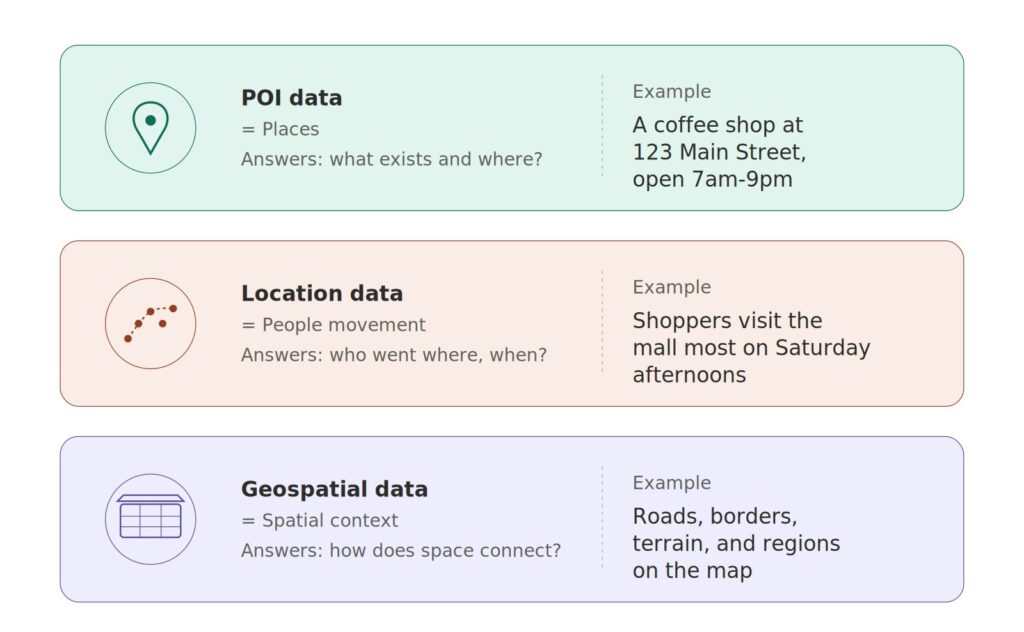
A Simple Way to Remember It
It boils down to the following:
- POI data = Places
- Location data = People movement
- Geospatial data = Spatial context
Keeping that separation clear is what allows everything else to fall into place.
When you start with the right dataset for the right question, everything downstream — from targeting to analysis to expansion — becomes easier to trust.
And in a space where small inaccuracies quietly compound over time, that clarity isn’t just useful.
It’s essential. If you want to move beyond surface-level business location data and work with datasets you can confidently act on, take a closer look at how Xtract.io approaches POI and location datasets differently.