Are you overpaying?
Turn complex CAM reconciliations into a faster, more accurate process with LeaseArc.
- Automated reconciliation
- Overcharge detection
- Invoice management
- AI lease abstraction
Automate CAM reconciliations and uncover discrepancies quickly.
Try it Free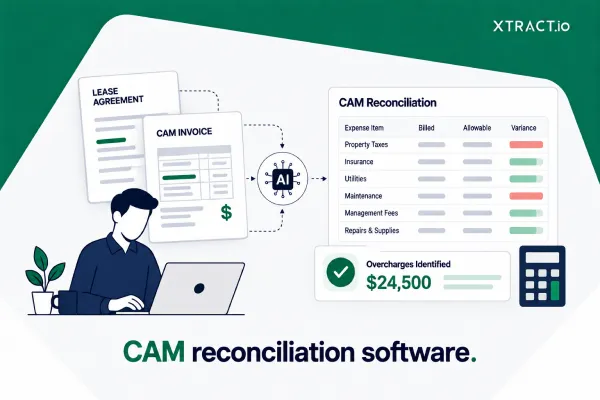
Reconciling Common Area Maintenance (CAM) charges can become increasingly complex as a commercial real estate portfolio grows. Every lease can define recoverable expenses differently, with its own exclusions, caps, pro-rata share calculations, administrative fees, and other negotiated terms.
For lease administration and finance teams, this means CAM reconciliation is rarely a simple comparison of estimated and actual expenses. The numbers have to be interpreted within the context of each lease.
This is where CAM reconciliation software comes in.
Instead of relying heavily on spreadsheets and disconnected lease records, it provides a structured way to manage the data involved in CAM reconciliation and support more consistent reconciliation across a portfolio.
In this guide, we’ll look at where traditional CAM reconciliation creates challenges, how automation changes the process, what capabilities to look for in a solution, and the CAM reconciliation software options available in 2026.
Table of Contents
Turn complex CAM reconciliations into a faster, more accurate process with LeaseArc.
CAM reconciliation software is a technology solution that automates the process of reviewing, validating, and reconciling Common Area Maintenance (CAM) charges against commercial lease agreements.
CAM charges typically cover shared property expenses such as maintenance, landscaping, security, utilities, property management, repairs, and other operating costs. Depending on the lease, tenants may be responsible for a specific share of these expenses. At the end of an accounting period, property teams need to determine whether the amounts billed and recovered accurately reflect the expenses and the terms agreed upon in each lease.
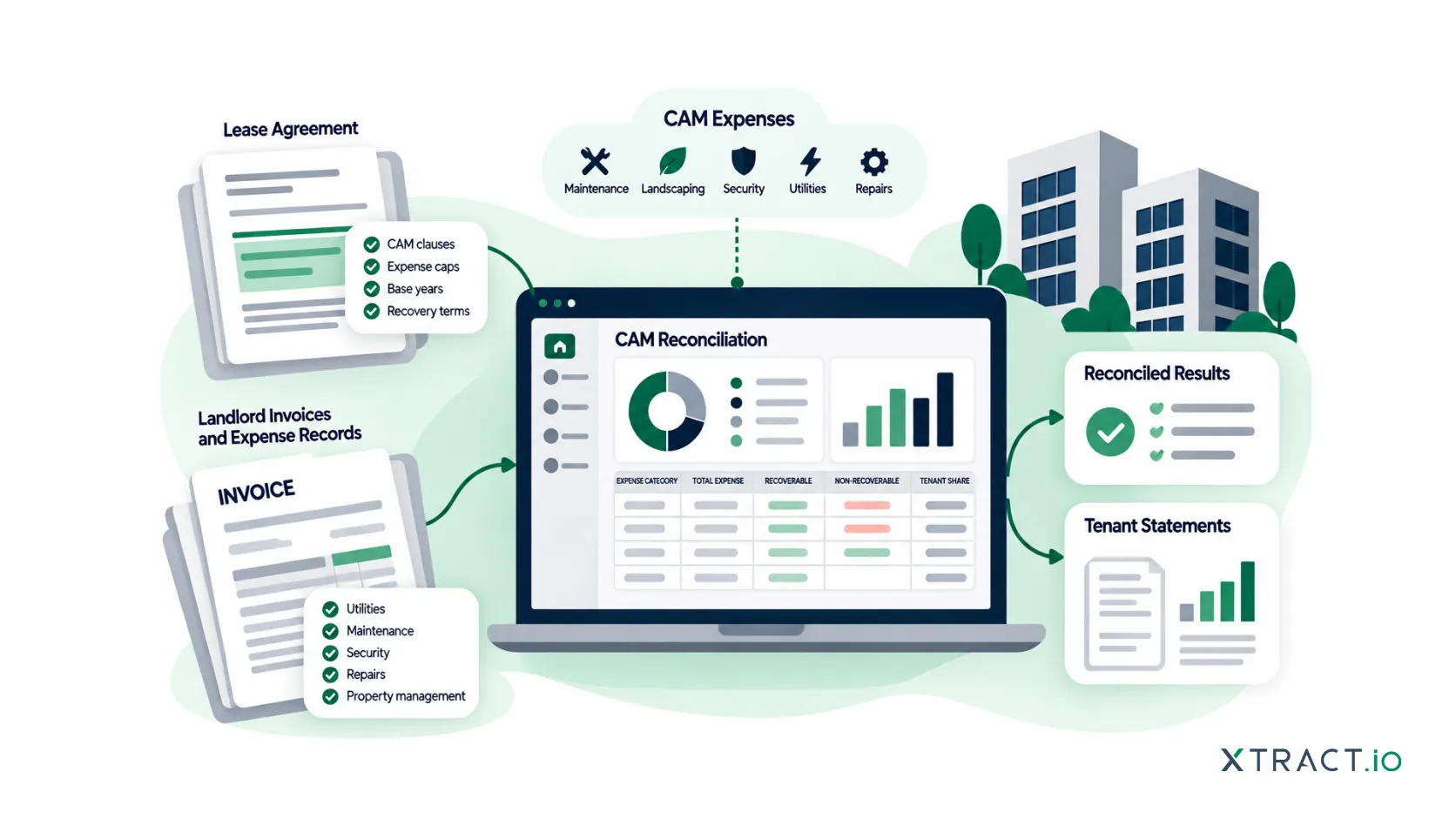
Traditionally, this involves manually reviewing lease documents, extracting recovery clauses, comparing landlord statements with expense records, and calculating tenant-specific obligations. CAM reconciliation software reduces this manual workload by connecting lease terms and financial data within a centralized workflow.
Manual CAM reconciliation becomes increasingly difficult as lease portfolios grow. Teams often rely on spreadsheets, disconnected systems, and manual reviews, creating several challenges:
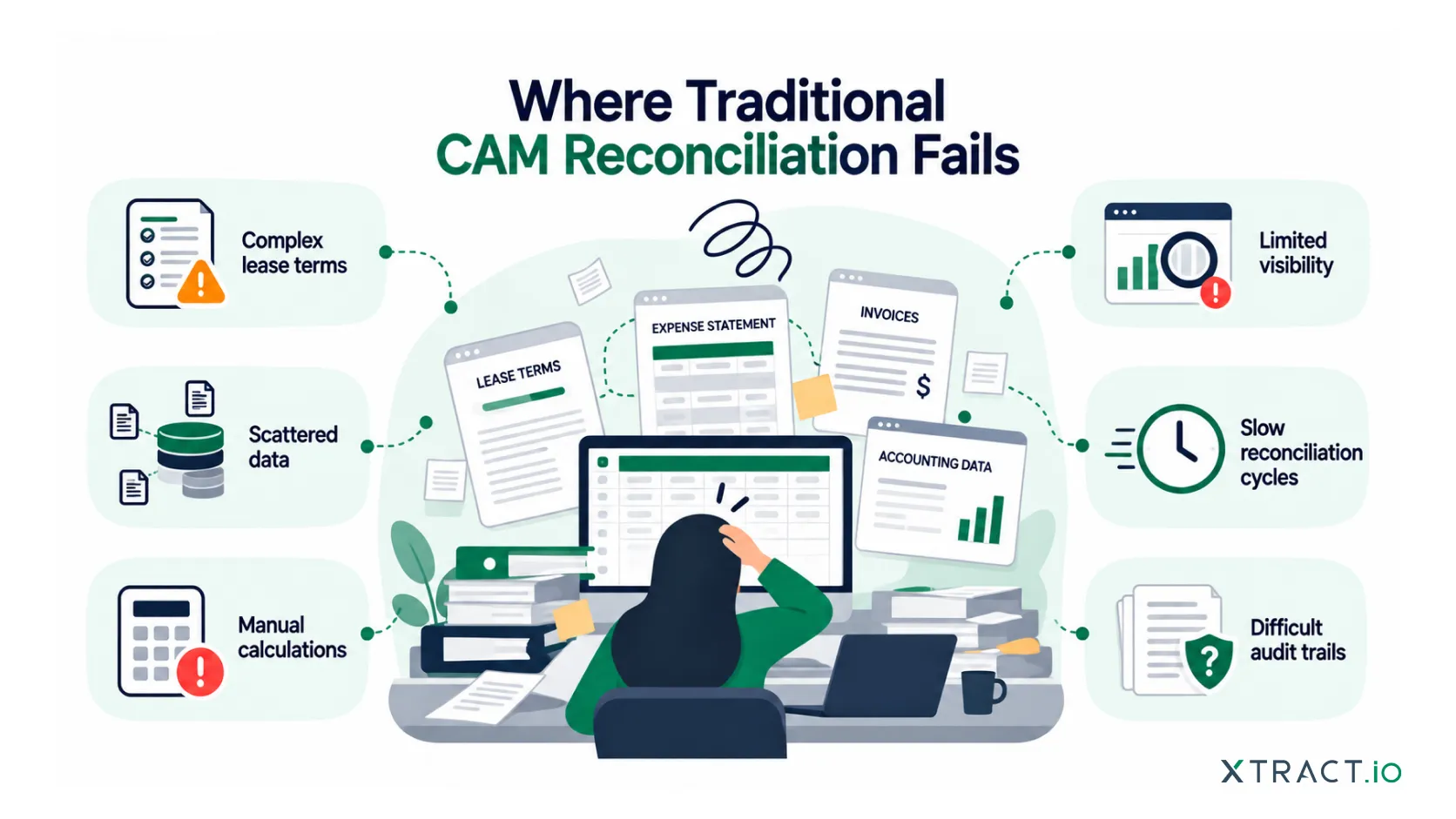
As portfolio complexity increases, these limitations can make it harder for teams to reconcile CAM expenses consistently and identify potential recovery opportunities.
Automating CAM reconciliation can help commercial real estate teams handle complex lease requirements more consistently while reducing the effort involved in manual review.
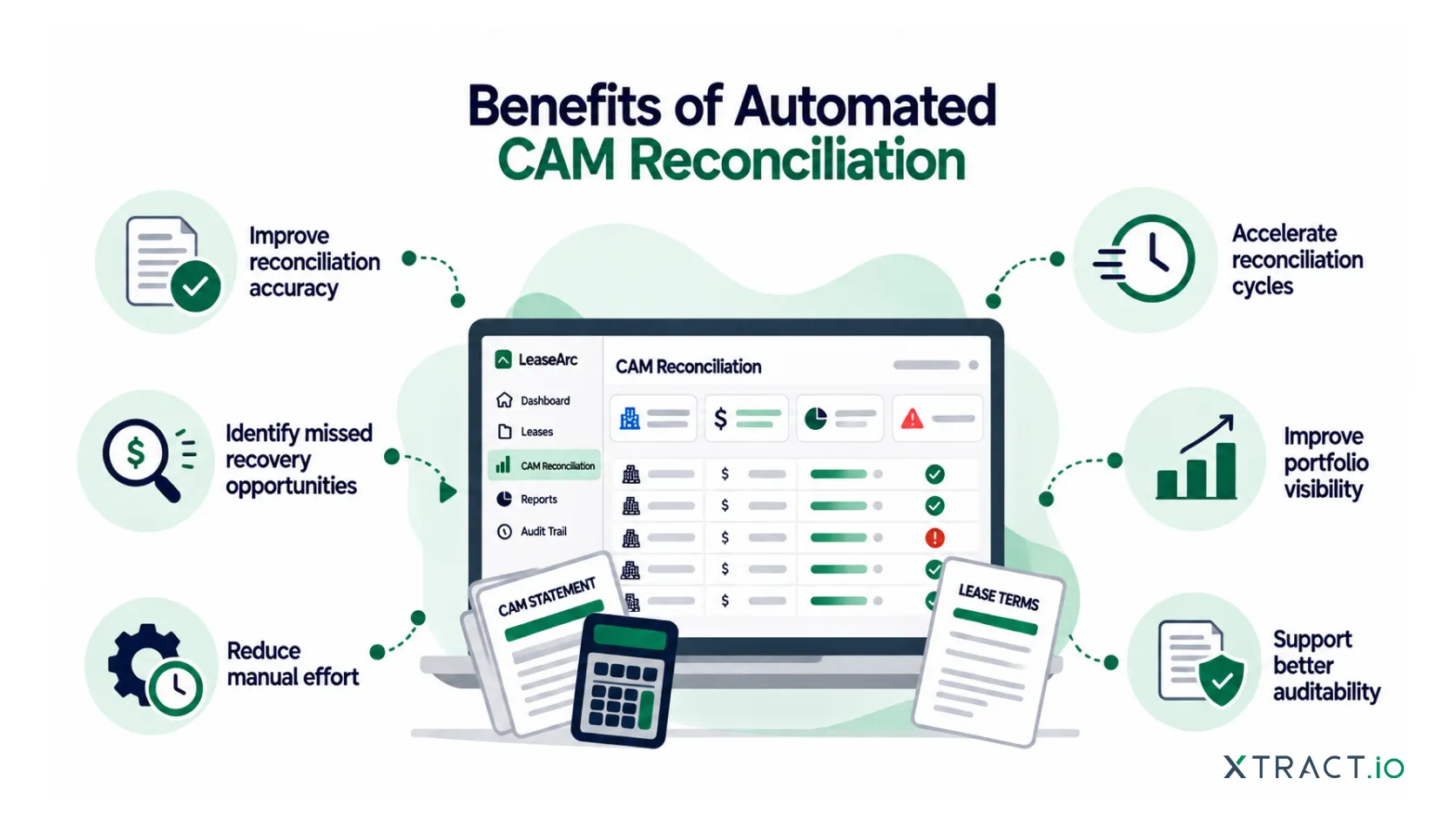
Automated calculations reduce dependency on manual data entry and spreadsheet formulas, helping minimize calculation errors and inconsistencies.
Software can help teams identify discrepancies between actual expenses, tenant obligations, and amounts already recovered, making potential under-recoveries easier to investigate.
Automating repetitive reconciliation activities allows lease administration and finance teams to spend less time reviewing spreadsheets and performing calculations manually.
A more structured and automated process can reduce the time required to review CAM expenses and complete reconciliations across multiple properties and tenants.
Centralized reconciliation data gives teams a clearer view of CAM expenses, recoveries, discrepancies, and outstanding items across the portfolio.
Maintaining reconciliation data and adjustments in a structured system makes it easier to review calculations and trace the basis for reconciliation results.
CAM reconciliation software connects lease data, financial information, and recovery rules in one system. Instead of requiring teams to manually cross-reference these sources, the software uses the information to support reconciliation at scale.
At a high level, the software works by:
Turn complex CAM reconciliations into a faster, more accurate process with LeaseArc.
Not all CAM reconciliation software handles lease provisions and expense recovery in the same way. When evaluating a solution, look beyond basic automation and consider whether it can accurately handle the contractual and financial complexity of your portfolio.
Lease agreements contain the rules that determine what tenants can be charged and recovered. AI-powered lease abstraction can extract relevant CAM provisions, including expense caps, exclusions, base years, pro-rata shares, and recovery terms, and convert them into structured data for reconciliation.
Invoices and expense statements provide the underlying data needed for CAM reconciliation. Automated invoice processing can capture key information from invoices, categorize expenses, and reduce manual data entry when bringing financial records into the reconciliation workflow.
CAM obligations vary from one lease to another. The software should support provisions such as expense caps, exclusions, base years, expense stops, administrative fees, and recovery percentages rather than applying a standard formula across the portfolio.
It should allow teams to organize operating expenses into relevant recovery pools. Expenses can then be categorized by lease terms, helping distinguish recoverable, non-recoverable, and tenant-specific costs.
Tenant recoveries often depend on leased area, occupancy, or another allocation method defined in the lease. The software should calculate each tenant’s applicable share and accommodate different allocation methods across properties and leases.
Gross-up provisions and CAM caps can significantly affect recoverable expenses. Look for software that can apply these calculations according to the specific lease, including different cap structures, base-year provisions, and occupancy assumptions.
The system should make it easy to identify differences between actual expenses, amounts billed, and amounts recoverable. Exception handling helps teams focus their review on unusual charges, potential over- or under-recoveries, and items requiring further investigation.
CAM calculations should be easy to validate after reconciliation is completed. An audit trail should connect reconciliation results to the underlying lease terms, expense data, calculations, and adjustments so teams can trace how a figure was derived.
The software should provide clear reconciliation reports showing expenses, allocations, recoveries, adjustments, and final balances. Tenant-ready statements with supporting detail can make it easier to communicate reconciliation results and resolve questions or disputes.
CAM reconciliation should not create another isolated data source. Integration with accounting, ERP, property management, and lease administration systems can reduce duplicate data entry and help keep financial and lease information aligned.
A consistent approach can help teams improve CAM reconciliation accuracy and minimize missed recoveries.
The right CAM reconciliation software should fit your lease portfolio, existing systems, and reconciliation requirements, not simply offer the longest feature list. Consider these factors before making a decision:
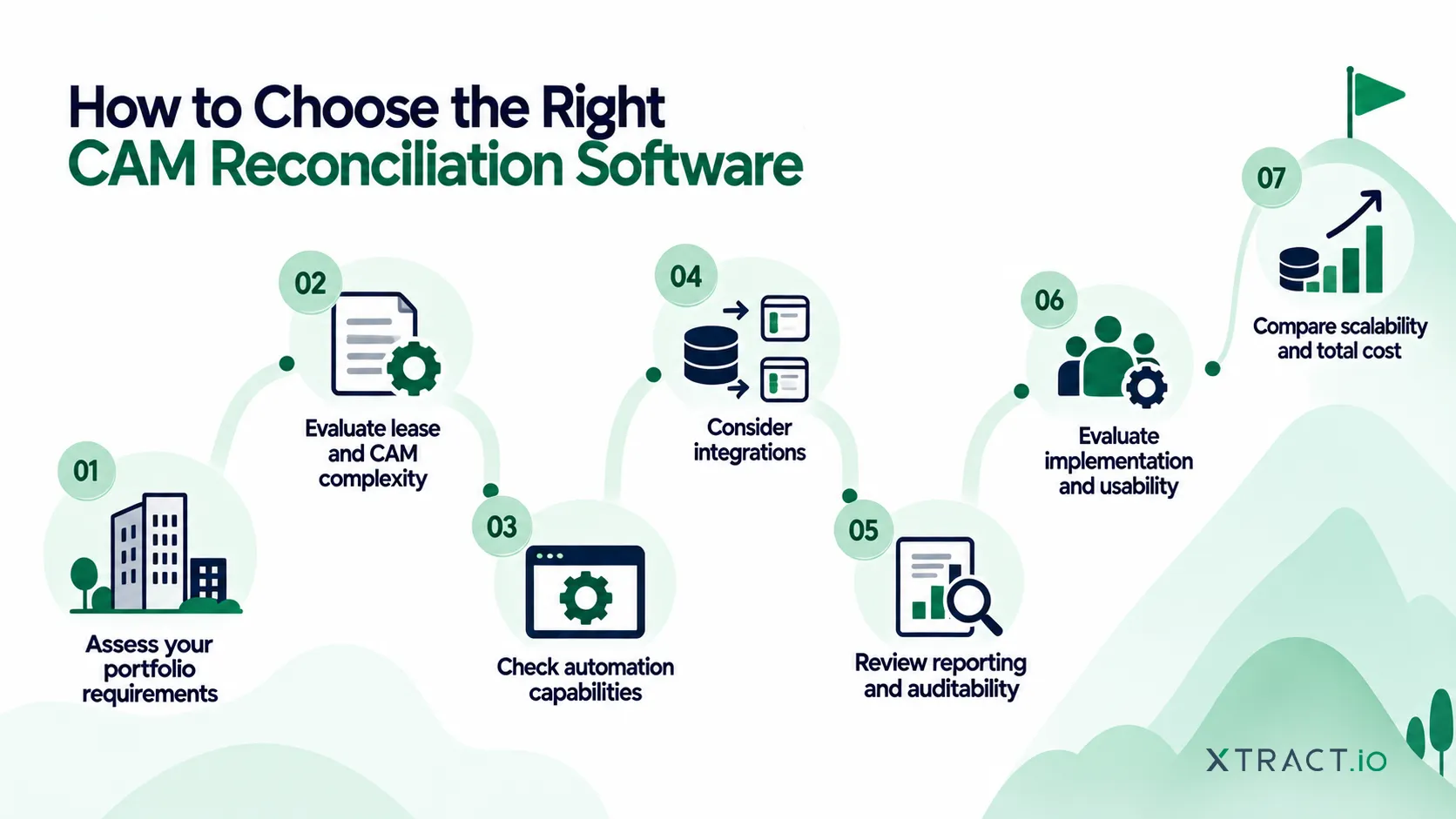
Consider the number of leases, properties, tenants, and different lease structures you manage. A solution should be able to handle your current portfolio while supporting future growth.
Check whether the software can accommodate the specific provisions in your leases, including caps, exclusions, gross-ups, base years, pro-rata shares, and different recovery structures.
Look at how much manual work the platform actually removes. Consider capabilities such as AI lease abstraction, automated invoice processing, calculations, exception detection, and reporting.
Ensure the software can connect with your existing lease administration, property management, accounting, and ERP systems. Strong integrations can reduce duplicate data entry and improve data consistency.
The platform should provide clear reconciliation reports and maintain an accessible record of calculations, adjustments, and supporting data.
Consider how easily your team can adopt the software, migrate existing data, configure lease rules, and incorporate it into existing workflows.
Look beyond the initial subscription price. Consider implementation costs, portfolio growth, user requirements, integrations, support, and the overall value delivered as your reconciliation volume increases.
Turn complex CAM reconciliations into a faster, more accurate process with LeaseArc.
The right CAM reconciliation software depends on your portfolio size, lease complexity, existing systems, and the level of automation your team needs. Some platforms offer CAM reconciliation as part of a broader commercial property management suite, while others focus more heavily on lease intelligence and financial automation. Here are five CAM reconciliation software options to consider in 2026.

LeaseArc is an AI-powered lease intelligence platform designed for commercial real estate teams. It combines lease abstraction, lease administration, financial workflows, and CAM audits in a single platform, helping teams connect contractual lease terms with financial data and recovery processes.
Custom pricing based on portfolio requirements.
CRE teams looking for an AI-native platform that combines lease intelligence, CAM automation, and financial workflows.

Yardi provides CAM reconciliation as part of its broader commercial property management and accounting ecosystem. Its platform connects lease administration, operating expenses, tenant recoveries, property accounting, and financial reporting, making CAM management part of a larger CRE workflow.
Custom pricing based on modules, portfolio, and implementation requirements.
Large commercial real estate organizations that need CAM within a broader property management and accounting ecosystem.

MRI Software offers a broad commercial real estate technology platform covering property management, lease administration, accounting, and financial operations. Its commercial solutions support CAM expense recovery and reconciliation alongside other property and lease workflows.
Custom enterprise pricing.
Mid-market and enterprise CRE organizations managing complex commercial portfolios.

AppFolio is a cloud-based property management platform that combines property operations, accounting, lease management, and reporting. Its commercial property capabilities can support CAM expense management and tenant-level recovery workflows.
Pricing varies based on portfolio size, products, and requirements.
Small to mid-sized property management organizations looking for an integrated property management and accounting platform.
Re-Leased is a commercial-first property management platform that combines lease administration, property management, accounting integrations, and CAM reconciliation. Its platform is designed to help commercial property teams manage expenses, recoveries, and tenant-level financial information from a centralized system.
Custom pricing based on portfolio requirements.
Commercial property managers and owner-operators looking for a commercial-focused platform with CAM and accounting capabilities.
| Software | Primary focus | Best for | Pricing model | Free trial |
|---|---|---|---|---|
| LeaseArc | AI lease intelligence | Multi-location occupiers | Custom | |
| Yardi | Property management | Enterprise CRE portfolios | Custom | |
| MRI Software | Commercial property management | Mid-market and enterprise CRE | Custom | |
| AppFolio | Property management | Small to mid-sized property managers | Custom | |
| Re-Leased | Commercial property management | Commercial property managers | Custom |
Turn complex CAM reconciliations into a faster, more accurate process with LeaseArc.
The ROI of CAM reconciliation automation comes from two measurable areas: reducing the cost of reconciliation and increasing the value of CAM recoveries.
Consider a portfolio of 500 leases, where each annual reconciliation takes approximately 4 hours of manual effort. At a fully loaded labor cost of $40 per hour, that represents 2,000 hours and $80,000 in annual reconciliation costs.
Now consider the recovery opportunity. If automated reconciliation identifies just $500 in additional recoveries per lease, the portfolio could uncover $250,000 in additional annual recoveries.
Together, that represents $330,000 in annual financial impact, $80,000 in reconciliation costs that can be addressed through automation, and $250,000 in potential additional recoveries.
For large lease portfolios, even relatively small improvements in reconciliation efficiency and recovery accuracy can translate into significant financial returns, making CAM automation a measurable investment rather than simply an operational upgrade.
LeaseArc is the only AI platform built exclusively for commercial tenants, giving occupiers a dedicated system for managing the complexity of their lease portfolios. Rather than adapting a landlord-focused property management platform to an occupier’s needs, LeaseArc is designed around the operational, financial, and legal challenges commercial tenants face.
LeaseArc brings real estate, finance, and legal teams onto one unified platform, creating a shared source of truth for lease obligations, financial commitments, and critical lease activities. This helps teams move beyond reactive lease administration and take a more proactive approach to controlling occupancy costs and preventing avoidable overcharges.
For CAM reconciliation, that occupier-first approach means CAM is not treated as an isolated accounting task. It sits within the broader context of the tenant’s lease obligations, financial exposure, and portfolio operations, helping occupiers make better decisions across the entire lease lifecycle.
Ready to take control of your lease portfolio? Start your free trial of LeaseArc.
What are CAM reconciliations?
CAM reconciliation is the process of reviewing the Common Area Maintenance charges billed by a landlord against the terms of your lease. For occupiers, it helps determine whether you have been charged the correct share of operating expenses and whether any charges fall outside the agreed lease provisions.
What is CAM reconciliation software?
CAM reconciliation software helps occupiers automate the review of CAM charges across their lease portfolio. It connects lease terms with invoices and expense data to help validate landlord charges, identify discrepancies, and uncover potential overcharges.
Who uses CAM reconciliation software?
CAM reconciliation software is typically used by commercial real estate, finance, and legal teams within tenant organizations. It gives these teams a centralized view of lease terms, CAM charges, and reconciliation results when reviewing occupancy costs across multiple properties.
How much does CAM reconciliation software cost?
Pricing varies based on factors such as portfolio size, number of users, modules, integrations, and implementation requirements. Many platforms use customized pricing rather than a standard public rate.


Growth Marketer
Connecting brands and people through a thoughtful blend
of creativity, strategy, and purpose.
Turn complex CAM reconciliations into a faster, more accurate process with LeaseArc.
Xtract.io provides cognitive data automation solutions, enabling businesses to transform their operations seamlessly. Our flagship platform, XDAS, is designed to streamline complex workflows and efficiently manage large volumes of data. With 200+ solutions and workflows, XDAS accelerates deployment and enhances operational performance, driving tangible results.
+19295566370
[email protected]Prince Kushal Towers, Ground Floor, A Wing, No. 138/805, Anna Salai, Chennai, Tamil Nadu 600002


