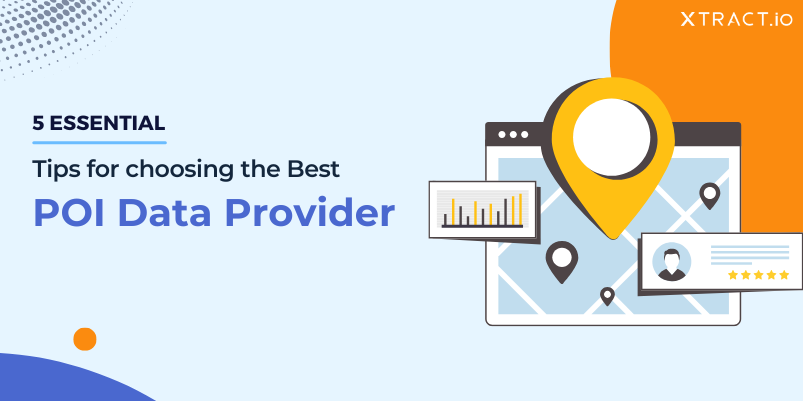
Quick answer: Choosing the right POI data provider isn’t just about finding a large dataset at the lowest price. The primary criteria for a POI dataset are that it has to be accurate, verified, up to date, relevant to your business needs, and come from reliable sources. Ideally, the best POI or location data provider should meet these standards. So, before making a decision, focus on five key factors: data quality, geographic coverage, update frequency, data sources, and customization. Together, these factors lead you to a provider you can count on while your company scales.
U.S. Bureau of Labor Statistics data indicates that around 50% of newly launched companies shut down before their fifth year. The reasons vary, but decisions built on unreliable location information are a risk you can avoid. Choosing a location data provider is often harder than deciding to use location data at all, because the market is crowded with vendors that each claim the most accurate and comprehensive datasets. Before you commit to a POI data provider, check how well it fits your business needs, how well it scales, and how easily it integrates with the tools you already use.
This guide walks through the major factors to weigh, the questions to ask, and the red flags to watch for.
What is POI data, and why does POI data provider matter?
Points of Interest data, or POI data, describes important places and locations. This can include commercial areas, tourist spots, public utilities, and other key sites. Records generally list a place’s name, street address, and contact information, along with additional geographic attributes. POI data can also show things like customer opinions, brand presence, and business trends.
POI data is used for site selection, planning expansions, and market analysis, so mistakes in the data can directly affect your decisions. Whether you buy data for one city or an entire database, wrong location data can mislead your team and put your business at risk. This is why choosing the right location data provider is just as important as deciding to use data at all. Xtract.io has been a leader in this field for nearly twenty years, keeping its data reliable with regular updates.
How does outdated POI data hurt business decisions?
Location data is always changing. Stores open, close, move, or change names, so data that was accurate a few months ago might be wrong now. Outdated Point-of-Interest data leads to bad insights, and those mistakes can be costly.
Assume that a real estate investor is assessing a neighborhood through its commercial properties, attractions, and landmarks. If the POI database behind that analysis is outdated, the area may look like it is thriving when many of the listed outlets have already closed. The investor ends up with a poor investment built on inaccurate location details.
The same problem affects retailers choosing store sites, franchises mapping territories, and marketers planning local campaigns. Accurate business location data tells each of them where customers and competitors actually are. A reliable and leading POI data provider like Xtract.io refreshes records frequently and verifies them against current information. You can also review our published resources to see how it has solved real-world challenges across industries.
What to check when selecting a POI data provider?
Here are the five attributes to segregate strong-match providers from the rest.
1. Data quality
Accurate, complete records are the basic criteria for every location decision. A well-maintained POI database should let you:
- Verify if each record in the dataset matches a real-time, valid location.
- Make sure key attributes such as name, address, latitude, and longitude are present.
- Watch for repeated entries of records, empty fields, and uneven formatting.
Ask any POI data provider how they validate records and whether their validation process combines automated checks with human-in-the-loop review. Strong-fit location data providers can explain their quality and validation process explicitly in plain terms and share accuracy standards.
2. Data coverage
Choose the location data provider with broad data coverage across regions and industries. Ask whether the provider can:
- Extend globally to support future expansion plans.
- Serve diverse and niche markets and fulfill every dataset request.
- Cover both major chains and independent local businesses.
Strong data coverage means the POI database you buy today will not limit your growth tomorrow. Request a sample in your target regions and categories, then compare it against what you see on the ground. Gaps in data coverage are easy to spot in a sample and costly to discover after you sign.
3. Data update frequency
Data freshness plays a major role in the relevance of the insights and decisions you make from the data.
Check if the provider:
- Refreshes its data in real time or on a regular, frequent schedule.
- Uses dynamic refreshes and change detection, so you can spot inefficiencies and opportunities early
- Publishes a clear refresh schedule for each region and category
A POI database that is refreshed once a year cannot support decisions that are made every week. Match the provider’s refresh cadence to the pace of your business.
4. Data sources
Data credibility is an inevitable aspect of any business, but verifying accuracy can be difficult. For that reason, you should find out exactly where the data originates.
Seek out:
- Open and well-documented methods for collecting and verifying data
- Records drawn from reliable government sources and widely recognized business directories
- On-the-ground validation by the POI data provider
If a location data provider can’t name its sources or relies on a single scraped feed, it’s risky to make decisions based on its data.
5. Data customization options
No two businesses share the same requirements. Every business has its own. And data customization is what lets a dataset adapt to yours. It improves current insights to your specifications without interrupting operations.
To evaluate the bandwidth of customization of a provider, check whether:
- Features and coverage can adapt to your specific use case, such as brands, categories, or geographies.
- Export formats are flexible enough to integrate with internal systems.
- Access options include a POI data API as well as bulk files.
- You can add or remove attributes without a long implementation cycle.
A provider that offers tailored business location data lets you pay for what you need instead of forcing your workflows to align with a fixed product.
How do you incorporate POI data into the system you already use?
Most teams want data that works easily with GIS platforms, CRM software, and analytics tools, without much extra work. Choose a provider that offers a POI data API for real-time access and also supports bulk delivery. APIs are good for live lookups, while bulk files are best for large or scheduled uploads. In both cases, the business location data should have a consistent format.
| Delivery format | Best for |
| API | Real-time access inside apps and dashboards |
| CSV | Spreadsheets and quick analysis |
| JSON / XML | Developer workflows and system integrations |
| GeoJSON / Shapefile | GIS and mapping tools |
Before you buy, test the integration with a small sample of the POI database. A POI data API that is well documented and returns clean, consistent fields will save your engineering team weeks of work.

How should you weigh pricing and customer support?
It’s not just about what the pricing is; what you get from it matters the most. Prefer providers whose pricing is transparent and fits within your budget line when you compare location data vendors. Avoid providers that hide or don’t clearly explain pricing for updates, features, extra regions, or POI data API calls. Also, check how responsive and approachable the team is, and whether support is easy to reach when issues come up.
Xtract.io offers competitive pricing along with dedicated geospatial data solutions and support, so businesses get the most from their POI data investment. To watch the data at work, you can request a free data demo.
Quick checklist: questions to ask any POI data provider
| Factor | Question to ask | Good sign |
| Quality | How are records/data validated? | Automated checks with human-in-the-loop review |
| Coverage | Which geographies and niches are covered? | Worldwide presence, specialized categories |
| Freshness | What is the data’s refresh frequency? | Real-time or dynamic updates |
| Sources | Where does the data come from? | Government records, verified directories |
| Customization | Which formats and filters are available? | POI data API, CSV, JSON, GeoJSON |
| Support | What are the response times? | Dedicated, prompt support |
Frequently Asked Questions(FAQ)
A POI data provider, or location data provider, collects, verifies, and delivers information about real-world places of interest, such as businesses, landmarks, and public facilities. They make that data available to businesses to use for planning, analysis, and expansion.
Businesses turn to Points of Interest data to choose where to expand and which sites to prioritize. It supports site selection, expansion planning, market analysis, and hyper-local marketing. It also shows where businesses and landmarks are located and how they evolve in real time.
POI data, or any data, for that matter, should be updated as frequently as possible for accurate decision-making. Regular updates and dynamic refreshes that detect changes are important because businesses can open, close, or move to new locations at any time.
Look for a POI data provider that supports API access plus common file formats like CSV, JSON, XML, GeoJSON, and Shapefile for bulk delivery. That way, plugging the data into the tools and workflows you already have becomes simpler.
POI data covers a wide range of places. From shops and restaurants to tourist attractions, hospitals, and public facilities, it covers all places of interest. At the same time, business location data focuses specifically on commercial locations, such as retail stores, office branches, and business outlets.
Ask for a sample dataset covering your target regions and categories, then compare it with real-world locations. Also, check how wide, complete, accurate, and up-to-date the data is.
Conclusion
Choosing the right POI data provider does not mean finding a provider that offers competitive pricing. You need to look at data accuracy, quality, geographic coverage, refresh cycle, and data sources. It’s also essential to check whether the location data provider can customize datasets as per your needs, integrate with your existing systems or workflow, offer reliable support when you need it, and make the overall process approachable.
The right provider makes it easier to work with accurate, up-to-date location data and make more informed business decisions. Xtract.io combines high-quality POI datasets with competitive pricing, flexible data delivery to match your business requirements, and dedicated support to help you find the data that fits your needs. Talk to our data expert team to explore your options and find the right POI data solution for your business.