XDAS Approach
To meet the demand for deep financial insights, the XDAS team built a multi-stage automated workflow to extract, validate, and deliver audit-ready data from complex annual reports.
Intelligent analysis for scalability
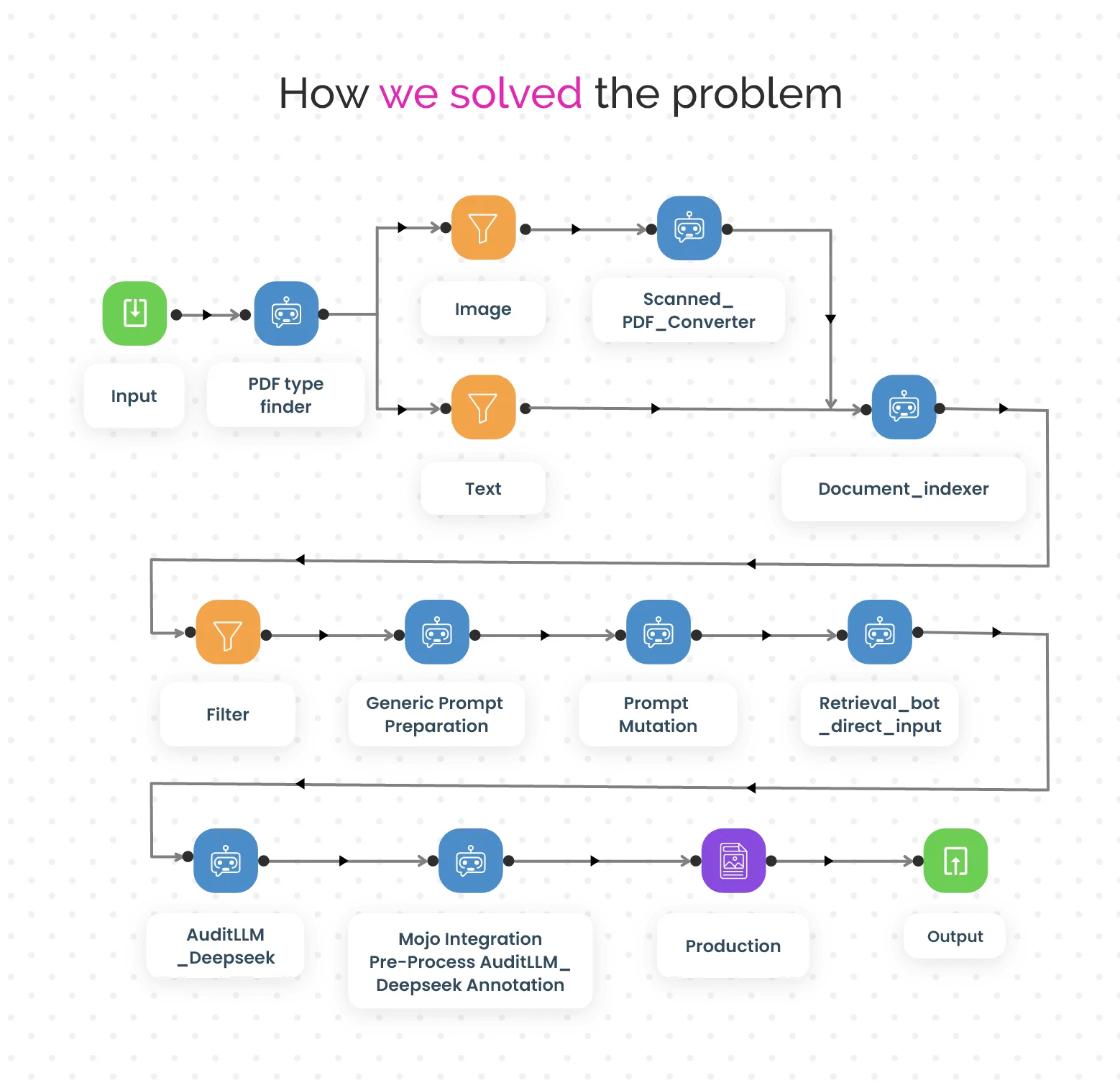
The Analyzer Bot identified report types and key sections like the Balance Sheet and P&L. A Profiler Bot then captured metadata, including page count and OCR quality, allowing the client to scale processing across diverse document formats without manual intervention.
Structural indexing for speed
To handle 200+ page documents, the Indexer Bot broke PDFs into labeled chunks and searchable vectors. This allowed the system to pinpoint data buried deep in footnotes, significantly increasing retrieval speed compared to manual data spreading.
Adaptive extraction for accuracy
When standard queries faced inconsistent layouts, the Prompt Mutation Bot adjusted the extraction logic in real-time. By fine-tuning the phrasing and context, it ensured high accuracy regardless of the company’s unique reporting style.
Dual-layer validation for risk reduction
Every figure passed through two automated gates to mitigate financial risk. The Validator Bot performed mathematical reconciliation, while the Audit LLM cross-referenced numbers against document notes to flag logical errors before delivery.
Confidence-based HITL for precision
Data points received a confidence score; low-confidence results were routed to the Mojo-based HITL interface. This targeted human review ensured near-perfect precision for high-stakes data without sacrificing the efficiency of the automated pipeline.
Standardized delivery for immediate action
The final 160+ financial attributes were converted into machine-readable JSON and CSV. This seamless output accelerated time-to-insight, enabling the client to integrate data directly into analytics platforms for immediate investment research.


 Go beyond automation and turn unstructured data into action
 Streamline data and turn ideas into workflows with a robust data automation suite
 Empowering innovation through purposeful partnerships.