XDAS Approach
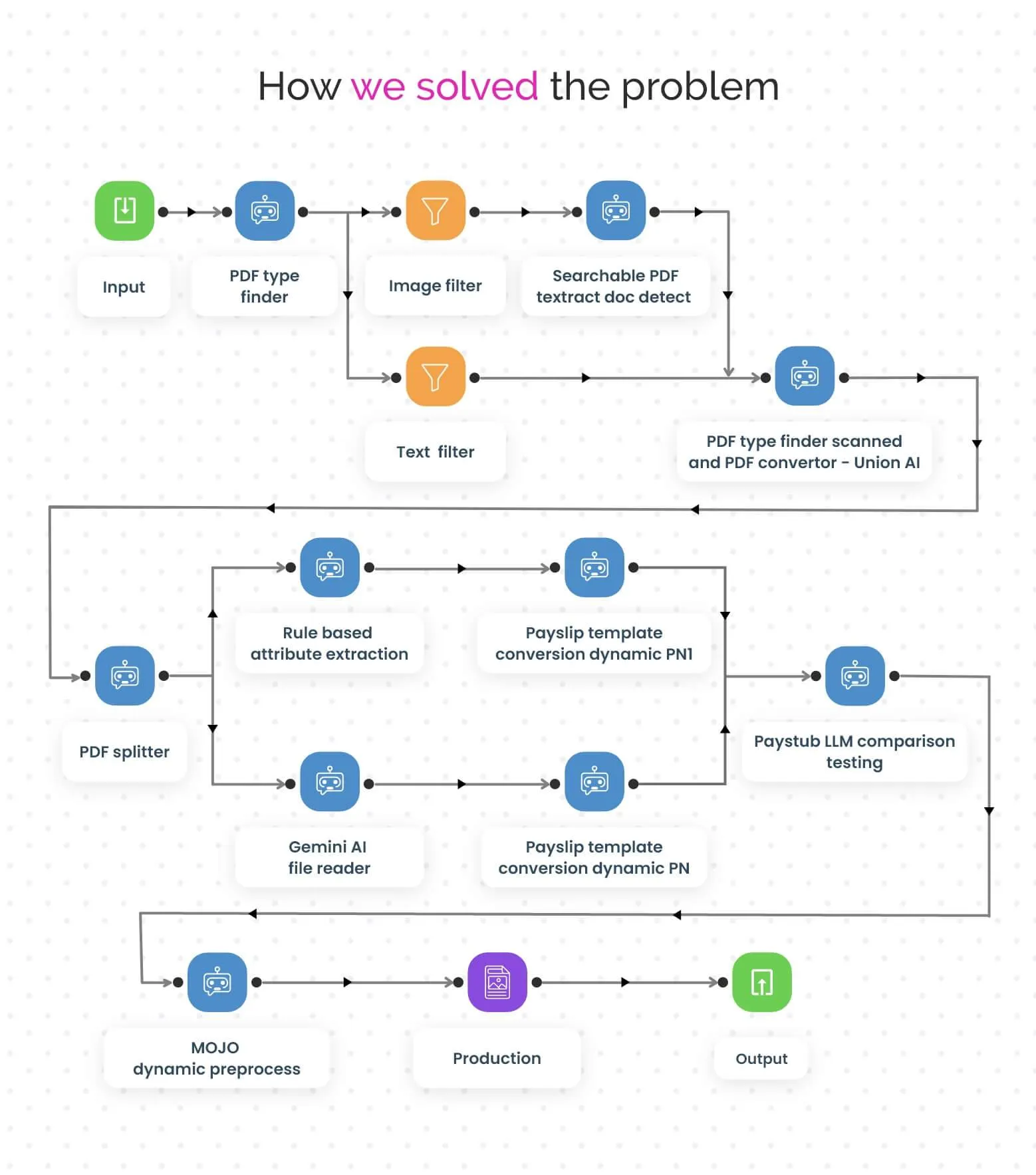
To meet the client’s payroll data extraction needs, the XDAS team designed a structured, automated workflow to streamline paystub processing, improve accuracy, and ensure consistent daily data delivery.
Seamless file intake and acknowledgment
The workflow began with the client uploading pay stub files to a secure S3 folder or via an API. Upon upload, the system automatically acknowledged receipt, ensuring traceability of daily inputs and eliminating manual tracking.
Automated document recognition and classification
Each incoming document was analyzed using the PDF type finder, which determined whether it was text-or image-based. Based on the results, files were routed through the appropriate pipeline, either direct text extraction or OCR processing, to ensure optimal readability and data capture.
During input analysis, documents were further classified into three standard layout groups to simplify downstream extraction:
- Group 1 – Textual & tabular: Single employee per page with structured tables or clear text layouts.
- Group 2 – Multi-column table: Single employee with multiple paystubs per page requiring column-wise parsing.
- Group 3 – Multi-employee, multi-period: Complex layouts containing multiple employees and multiple pay periods in grid-like tables.
This two-step classification enabled the extraction engine to apply the most suitable approach for each document group, improving both accuracy and efficiency.
High-accuracy extraction with dual-path processing
Once documents were classified, the classifier bot triggered the corresponding approach, each designed with dual-path extraction to maximize precision.
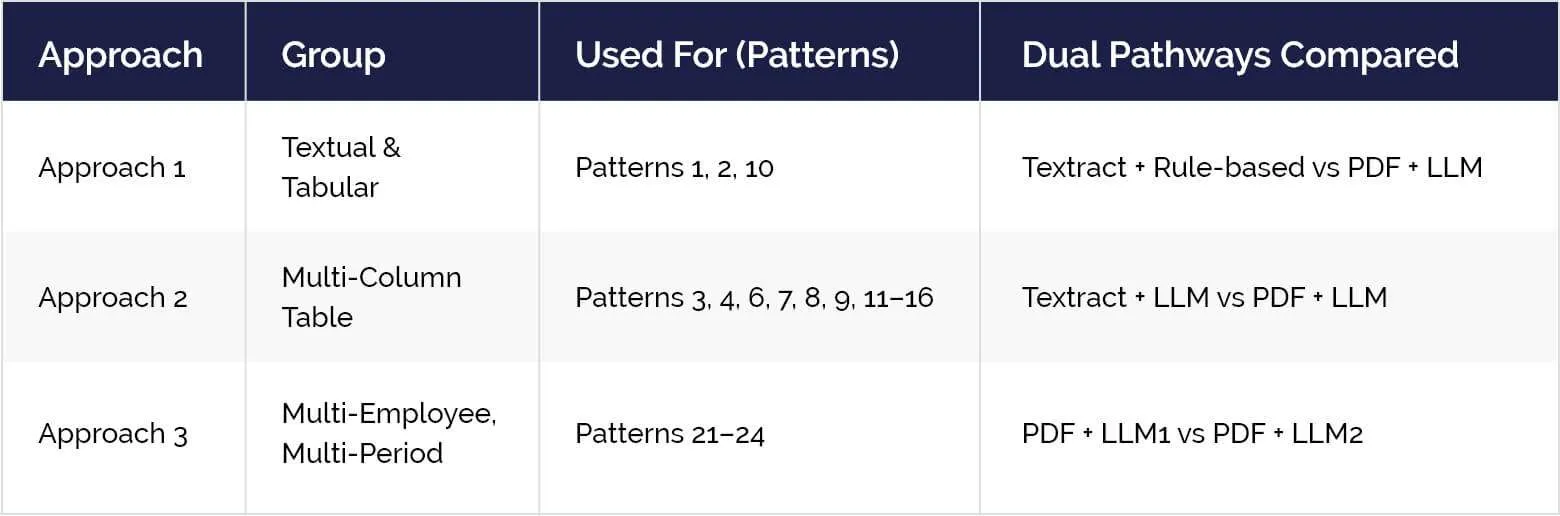
Each approach ran two extraction pathways in parallel. A comparison layer was then aligned and validated, automatically resolving discrepancies and merging the most reliable outputs. Extracted data, including employee details, gross pay, deductions, and tax components, was then standardized for further processing.
AI confidence validation with human-in-the-loop precision
Each extracted field underwent confidence-based validation to assess data reliability. Low-confidence outputs were routed to the HITL interface, where expert validators reviewed, corrected, and approved final results. This hybrid automation approach ensured precision while maintaining rapid turnaround.
Integrated client communication and delivery
At the end of each cycle, an automated summary email was sent to the client, detailing the files received, processed, and carried forward. The validated outputs were securely delivered via the XDAS platform, ensuring transparency and timeliness.
Adaptive learning and scalable performance
The workflow tracked key performance indicators, including accuracy, turnaround time, and exception rates. These insights were continuously used to fine-tune pattern recognition, extraction logic, and pathway selection, enabling scalable and efficient paystub processing even as input volumes grew.


 Go beyond automation and turn unstructured data into action
 Streamline data and turn ideas into workflows with a robust data automation suite
 Empowering innovation through purposeful partnerships.